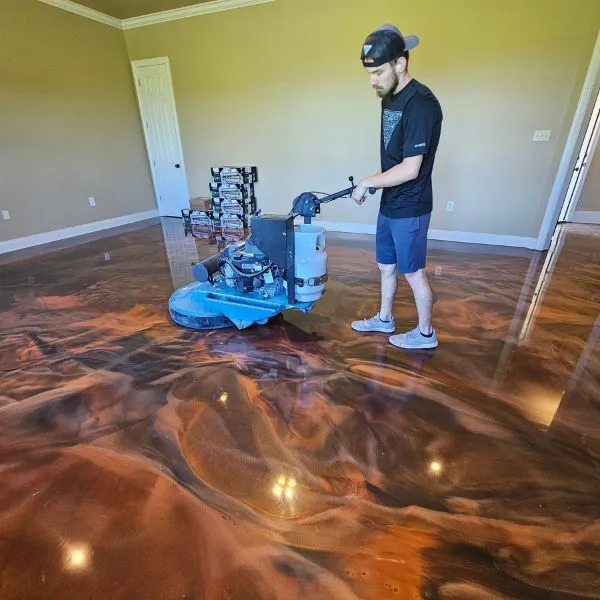
Once you've decided to coat your concrete, the next question is what it should look like. Most decorative epoxy floors in Pittsburgh come down to four main systems: full-flake (chip), metallic, quartz broadcast, and solid color. Each one has a different look, a different price, and a room it's genuinely best suited for — and picking the wrong one for the space is the most common design regret we hear about.
This guide walks a Pittsburgh homeowner through all four so you can match the right system to the right room and budget. We'll cover what each finish looks like, how tough it is, where it shines, and roughly what it costs — using the same per-square-foot ranges from our Pittsburgh epoxy flooring cost guide so the numbers line up.
Full-Flake (Chip) Epoxy — The Most Popular Choice
If you've seen a garage floor in the South Hills or Cranberry Township that looks like it's sprinkled with colored confetti, that's a full-flake system. Vinyl color chips are broadcast into a wet base coat, then locked in under a clear polyaspartic top coat. It is, by a wide margin, the most-requested decorative epoxy floor in the Pittsburgh area.
Why it's so popular
Flake floors are forgiving. The dense layer of chips hides minor slab imperfections, patch repairs, and the small surface variations common in older Allegheny County concrete — so the finished floor looks clean even when the slab underneath isn't perfect. The flakes also create a subtle texture underfoot, which adds slip resistance in a space that sees road salt, snowmelt, and wet boots all winter.
Durability and cost
With a polyaspartic top coat, a full-flake floor stands up to hot tires, dropped tools, and freeze-thaw cycling for many years. It typically runs $5 to $12 per square foot installed, putting it squarely in the middle of the range — affordable enough for a whole garage, durable enough to last. For most Pittsburgh garages, this is the system we recommend first.
Metallic Epoxy — The High-End, Art-Driven Finish
Metallic epoxy is the showpiece of the decorative world. Metallic pigments are suspended in a clear epoxy and then manipulated while wet — the installer moves the pigment to create swirling, three-dimensional effects that mimic marble, flowing lava, rippling water, or polished stone. No two metallic floors are ever identical, because the artistry happens live during the pour.
Where it belongs
Because it's more of a design statement than a workhorse, metallic shines in spaces people actually spend time looking at: high-end showrooms, finished basements, living spaces, and premium garages where the floor is part of the show. Homeowners in Mt. Lebanon, Sewickley, Fox Chapel, and Squirrel Hill often choose metallic for living areas because the marble-like swirl complements the brick and stone architecture the region is known for.
Durability and cost
A quality metallic floor sealed with polyaspartic holds up well in residential settings, though it's slightly less abrasion-tough than quartz and isn't the first pick for a heavy commercial workshop. It's the most premium of the common systems, typically $9 to $20 per square foot installed — the range reflects how many pigment layers and how much hand-work the design calls for. A smooth metallic floor can be slick when wet, so we add a fine anti-slip aggregate to the top coat anywhere water is a factor.
Quartz Broadcast — The Toughest System
Quartz broadcast trades the decorative drama of metallic for raw durability. Instead of vinyl flakes or pigment, a dense layer of colored quartz granules is broadcast into the coating, building a thick, hard-wearing surface that's the most impact-resistant and slip-resistant of the four systems.
Where it belongs
The granular texture and toughness make quartz the standard for commercial kitchens, restaurants, and food-service spaces around Pittsburgh, where health codes demand a sanitary, non-slip floor. It's equally at home in a serious home workshop or a high-traffic commercial garage. Anywhere people are on their feet, carrying things, and spilling liquids, quartz earns its keep.
Durability and cost
Quartz is the most rugged residential-and-commercial option, built to take impacts and constant abrasion. It runs $8 to $15 per square foot installed. You're paying for a thicker, denser build than flake — and getting the best slip resistance of any of these finishes in return.
Solid Color Epoxy — The Economical Workhorse
Solid color is exactly what it sounds like: a single, uniform color with no flakes, pigment swirls, or quartz. It's the most economical decorative system and the simplest to install, which is why it's the go-to for spaces where function matters more than show.
Where it belongs
Think utility and storage areas, basement workrooms, mechanical rooms, and budget-conscious garages. A solid gray or tan floor instantly cleans up a space, resists dust, and wipes down easily. It lacks the texture of flake or quartz, so for areas that get wet we add an anti-slip additive to the top coat.
Durability and cost
At $3 to $7 per square foot installed, solid color is the lowest-cost professional option. With proper diamond-grind prep and a polyaspartic top coat, it still dramatically outlasts any DIY kit — it just skips the decorative layer to keep the price down.
Epoxy System Comparison at a Glance
Here's how the four systems stack up side by side. Cost ranges are per square foot, professionally installed in the Pittsburgh area, and match our cost guide.
| Full-Flake | Metallic | Quartz Broadcast | Solid Color | |
|---|---|---|---|---|
| Durability | Very high | High | Highest | Good |
| Slip resistance | High (flake texture) | Low–moderate (needs additive) | Highest (granular) | Low (needs additive) |
| Look | Speckled, multi-color | Marble / lava swirl | Textured, granular | Uniform, single color |
| Best room | Garage, patio | Living space, basement, showroom | Workshop, commercial kitchen | Utility, storage, mechanical |
| Relative cost | $5 – $12 / sq ft | $9 – $20 / sq ft | $8 – $15 / sq ft | $3 – $7 / sq ft |
| DIY-able? | Partly (prep is the hard part) | No (artistry-dependent) | No (broadcast technique) | Partly (simplest) |
One caution on the DIY column: the decorative layer is rarely what makes or breaks a floor — the slab prep does. In Pittsburgh's older housing stock, missing vapor barriers, moisture vapor, and freeze-thaw exposure cause far more failures than a poorly broadcast flake. Even the "partly DIY-able" systems depend on diamond-grind prep and moisture testing to last.
Pick your size, finish, and color. Get your Pittsburgh price range in 60 seconds.
Open Floor Studio →Choosing the Right System by Room
The fastest way to narrow your choice is to start with the room. Here's how the systems map onto the spaces we coat most often in the Pittsburgh area.
Basements
Basements are extremely common in Pittsburgh's older housing stock, and they come with two design constraints: they run cool, and they can be damp. Most homes in Allegheny County are pre-1970 and were built without a vapor barrier under the slab, so before any decorative layer goes down, we run an ASTM F2170 in-situ relative humidity test and install a moisture-mitigation primer when readings warrant it. With that prep handled, a finished basement is a perfect canvas for metallic epoxy — the swirl turns a forgotten lower level into a living space. A solid color or flake works just as well in an unfinished basement workroom.
Garages
For the typical Pittsburgh garage, full-flake is the default. The flake texture adds slip resistance for snowy boots and road salt, hides slab imperfections, and the polyaspartic top coat shrugs off hot tires and freeze-thaw cycling. If the garage doubles as a showcase, a metallic floor steps it up to high-end — just plan for the anti-slip additive.
Living and showroom spaces
When the floor is meant to be admired — a finished living area, a home showroom, a feature room — metallic is the system that delivers a wow factor. Its marble-like depth pairs naturally with the brick and stone homes found across Mt. Lebanon, Bethel Park, and Fox Chapel.
Workshops and commercial spaces
For a serious home workshop, a commercial kitchen, or a high-traffic shop floor, quartz broadcast is the answer. Its dense granular surface gives the best slip resistance and impact toughness of any of these systems, which is exactly what a working floor demands.
Ready to Get Your Pittsburgh Quote?
Every project is different. Call us for a free, no-obligation estimate tailored to your specific space and goals.
Colors and Finishes
Once you've chosen a system, you still get to dial in the color and the level of shine. These two choices change the feel of a floor as much as the system itself.
Matte vs. gloss
A high-gloss top coat amplifies depth and reflection — it makes a metallic swirl pop and a solid color read richer, and it's the classic showroom look. A matte or satin finish hides dust and minor scuffs better, reduces glare, and gives a more understated, contemporary feel. Gloss shows off; matte stays low-key and practical. Both use the same durable polyaspartic chemistry, so it's purely an aesthetic call.
Popular Pittsburgh palettes
Around Pittsburgh, the most-requested colors lean toward neutrals, greys, and blues — tones that sit comfortably against the region's brick, stone, and traditional architecture. Greys and charcoals are the safe, timeless default for garages; warmer tans and earth tones suit basements and living spaces; and deep blues and metallic silvers show up most in feature rooms where a metallic floor is the centerpiece.
Custom flake blends and colors
Flake floors aren't limited to a single chip color — they're built from custom-blended chip mixes, so you can tune the blend to match your home's trim, cabinets, or color scheme. Solid-color and metallic floors can likewise be mixed to a wide range of custom tones. The easiest way to see how a blend or color reads at scale is to preview the combinations in our Floor Studio before you commit, then bring that look to your free quote.
Frequently Asked Questions
What is the most popular epoxy floor design in Pittsburgh?
Full-flake (chip) epoxy with a polyaspartic top coat is the most popular choice for Pittsburgh homeowners, especially in garages. The colored vinyl flakes add slip texture, hide minor slab imperfections and patch repairs, and let you match almost any color scheme. It is durable, forgiving, and priced in the middle of the range at roughly $5 to $12 per square foot installed.
Is metallic epoxy good for a basement?
Metallic epoxy can look stunning in a finished basement, but a Pittsburgh basement has to pass a moisture check first. Most homes in Allegheny County are pre-1970 and were built without a vapor barrier under the slab, so we run an ASTM F2170 in-situ relative humidity test and install a moisture-mitigation primer when readings warrant it. With proper prep and mitigation, a metallic floor handles the cool, sometimes damp conditions of an older Pittsburgh basement well.
Which is most durable — flake, metallic, or quartz?
Quartz broadcast is the toughest of the three. It packs a dense layer of colored quartz granules into the coating, which makes it the most impact-resistant and slip-resistant system and the standard for commercial kitchens and heavy workshops. Full-flake is a close, very durable second for homes, while metallic is more art-driven and slightly less abrasion-tough but still holds up well in living spaces and showrooms with a quality polyaspartic top coat.
Can I get a custom color for my epoxy floor?
Yes. Solid-color and metallic floors can be mixed to a wide range of custom tones, and flake floors use blended chip mixes you can customize to match your home. Popular Pittsburgh palettes lean toward neutrals, greys, and blues that suit the region's brick and stone architecture. You can preview size, finish, and color combinations in our Floor Studio before you commit.
Is metallic epoxy slippery?
A metallic floor with a smooth gloss top coat can be slick when wet, which is why we add a fine anti-slip aggregate to the top coat for garages, basements, and any area that may see water. For spaces where slip resistance is the priority, such as a workshop or commercial floor, a quartz or full-flake system provides more texture underfoot than a smooth metallic finish.
How much does metallic epoxy cost in Pittsburgh?
Metallic epoxy in Pittsburgh typically runs $9 to $20 per square foot installed, making it the most premium of the common decorative systems. The range reflects the artistry involved, the number of metallic pigment layers, and slab prep needs. For comparison, solid color runs $3 to $7, full-flake with polyaspartic runs $5 to $12, and quartz broadcast runs $8 to $15 per square foot.
Related Articles
How Much Does Epoxy Flooring Cost in Pittsburgh? (2026 Price Guide)
Honest per-square-foot pricing by system type, garage size, and the local prep factors that affect cost.
Epoxy vs. Polyaspartic Flooring in Pittsburgh: Which Is Right for You?
Compare cost, durability, cure time, and UV stability for Pittsburgh garage and residential projects.
Commercial Epoxy Flooring in Pittsburgh: A Business Owner's Guide
Quartz, flake, and urethane-cement systems by industry — for Pittsburgh warehouses, kitchens, retail, and shops.