If you're searching for epoxy flooring prices in Pittsburgh, you've probably noticed that the straight answer is "it depends on your slab." This guide explains exactly what it depends on, so the quote from your free estimate makes sense line by line.
These are the same factors we weigh when quoting garage floor coatings, residential projects, and commercial spaces across Allegheny County and Western Pennsylvania.
They come from the specific prep requirements that Pittsburgh's concrete and climate demand, not from national averages pulled from an aggregator site.
The short answer: every floor in Pittsburgh is priced after a free on-site estimate, because the price depends on the size of the space, the condition of the slab (cracks, old coatings, moisture), the coating system and finish you choose, and the prep the concrete needs. Solid color is the lowest-cost system, a full-flake epoxy with a polyaspartic top coat — the most popular residential choice — sits in the middle, and metallic finishes run higher.
Pittsburgh Epoxy Flooring Cost by System Type
| Coating System | Relative Cost | Best For |
|---|---|---|
| Solid Color Epoxy | Lowest | Utility spaces, storage, budget-conscious |
| Full-Flake Epoxy + Polyaspartic | Moderate | Residential garages, patios, man caves |
| Quartz Broadcast | Higher | Commercial kitchens, restaurants, retail |
| Metallic Epoxy | Higher | Showrooms, living spaces, high-end garages |
| Urethane Cement | Highest | Heavy industrial, food processing, breweries |
Pick your size, finish, and color. Get your Pittsburgh price range in 60 seconds.
Open Floor Studio →Important note: A quote worth signing includes professional surface preparation (diamond grinding, crack repair, moisture testing) and a salt-rated polyaspartic top coat. Rock-bottom quotes often skip surface prep and use water-based retail products, and those floors can fail within months in Pittsburgh winters.
What Makes Pittsburgh Pricing Different
Pittsburgh isn't Cleveland, Columbus, or Philadelphia when it comes to epoxy flooring costs. Several local factors directly affect what you'll pay.
1. Pre-1970 Slabs Need Moisture Testing
The median Allegheny County home was built in 1954, and an estimated 60-70% of homes in the county are pre-1970 — built before vapor barriers under concrete slabs were standard. Without a vapor barrier, hydrostatic pressure pushes moisture up through the slab, and any coating on top will pop off from underneath. Professional prep in Pittsburgh therefore includes ASTM F2170 in-situ relative humidity testing, and a moisture-mitigation primer or vapor reduction barrier when readings warrant it. In markets with newer slabs, you skip all of this. Here, you can't — not without watching your floor fail.
Cost impact: the testing and, when readings warrant it, a moisture-mitigation primer or vapor reduction barrier add to the prep on your quote.
2. New Construction Concrete Needs Curing Time
Suburban growth in Cranberry Township, Wexford, Mars, Adams Township, and the I-79 North corridor means many garages have brand-new concrete slabs. New concrete needs a minimum of 28 days to cure before epoxy can be applied. New slabs may also have a surface curing compound that must be diamond-ground off before coating. Some contractors skip the wait and apply too early, leading to adhesion failure within the first year — the same way the threshold-failure pattern shows up in local reviews.
3. Slab Temperature Limits the Install Window
Pittsburgh's effective install window for traditional epoxy is roughly mid-April through mid-October, because epoxy requires a slab temperature of 50-55°F to cure properly. Concrete in an unheated detached garage often runs 35-50°F well into spring. Winter installs are still possible — but they require polyaspartic or polyurea systems, which cure as low as -20°F. Polyaspartic costs more per gallon than standard epoxy, so winter and shoulder-season installs may cost more. The upside: polyaspartic is also the right choice for Pittsburgh's salt and freeze-thaw conditions year-round.
4. Coal Mine Subsidence Affects Some Slabs
Approximately 230,000 homes in Allegheny County (roughly 42,000 within Pittsburgh city limits) sit over abandoned underground coal mines, per PA DEP. Mine subsidence can cause slab movement and cracking in neighborhoods like the South Hills, Squirrel Hill, Mt. Oliver, Brookline, and Carrick. A coating cannot bridge active subsidence movement. Stable, settled cracks can be properly repaired with crack-bridging primers and flexible sealers before coating — but if cracks suggest active movement, we will tell you to verify your home's status with PA DEP's mine map and consider PA Mine Subsidence Insurance before proceeding.
Ready to Get Your Pittsburgh Quote?
Every project is different. Call us for a free, no-obligation estimate tailored to your specific space and goals.
Cost Factors by Project Type
Residential Garage (Most Common)
- 1-car garage: about 200–250 sq ft
- 2-car garage: about 400–500 sq ft
- 3-car garage: about 600–750 sq ft
Size sets the starting point; slab condition and the finish move it from there. The most popular residential choice in Pittsburgh is a full-flake system with a polyaspartic topcoat. This system provides UV stability for Pittsburgh winters, hot tire resistance, and the decorative finish that transforms a garage into a functional living space.
Residential Interior (Kitchen, Living Room, Basement)
- Metallic and decorative finishes dominate
- Hand-worked decorative finishes cost more per square foot than a garage flake system
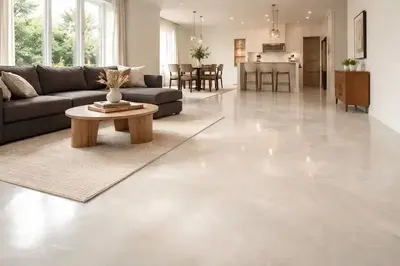
Pittsburgh-area homeowners in Cranberry Township, Mt. Lebanon, Sewickley, and Fox Chapel gravitate toward metallic epoxy for living spaces — the swirling, marble-like finish complements the region's older brick and stone architectural style.
Commercial Spaces
- Restaurant/retail: typically 500–2,000 sq ft
- Warehouse/industrial: typically 2,000–10,000 sq ft
Commercial projects often use quartz broadcast or urethane cement systems for USDA compliance, chemical resistance, or heavy traffic loads. The per-square-foot cost decreases with scale.
Patio / Outdoor
- Covered patio: typically 100–300 sq ft
- Outdoor spaces MUST use polyaspartic top coats (no standard epoxy)
What's Included in a Professional Quote (and What Isn't)
A legitimate Pittsburgh epoxy flooring quote should include:
- Concrete inspection and moisture testing
- Diamond grinding surface preparation (never acid etching)
- Crack repair with flexible polyurea fillers
- Primer coat (if moisture mitigation is needed)
- Base coat (epoxy)
- Decorative layer (flake, quartz, or metallic)
- Salt-rated polyaspartic top coat
- Cleanup and final walkthrough
Red flags in a quote:
- No mention of surface preparation
- A price far below every other quote (they're using retail products or skipping prep)
- Requiring payment in full before work starts
- No reference to moisture testing or slab condition assessment
- An out-of-area area code or out-of-market phone number
DIY vs. Professional — The Real Cost Comparison
| DIY Kit | Professional Installation | |
|---|---|---|
| Materials | Retail kit, thin coating | Included in quote |
| Equipment (grinder rental) | Rented by the day | Included |
| Your time | 2–3 full days | 0 (we handle everything) |
| Moisture testing | Not included | ASTM-standard testing included |
| salt-rated polyaspartic top coat | Not included | Included |
| Expected lifespan in Pittsburgh | 6 months – 2 years | 10 – 20+ years |
| Total cost (2-car garage) | Kit + rental + your time, plus removal if it fails | One price, after a free on-site estimate |
The trade-off is clear: a DIY kit costs less upfront but fails far sooner. In Pittsburgh's climate, DIY kits fail because they can't handle the moisture vapor, salt, freeze-thaw exposure, and threshold abuse that professional systems are engineered for.
How to Get an Accurate Quote in Pittsburgh
Three factors determine your final price more than anything else:
- Square footage — measure your space accurately (length x width)
- Concrete condition — cracks, stains, previous coatings, moisture issues
- System choice — solid color vs. flake vs. metallic vs. quartz
We provide free, no-pressure quotes that include a concrete condition assessment. No paid estimates. No sales pressure. Just an exact price based on your specific slab and the system that actually makes sense for your project. It also makes it easy to line us up against any other epoxy flooring company in Pittsburgh and compare the line items honestly.
Ready for a straight answer on your floor? Call (412) 388-9880 or request your free quote online. We'll assess your concrete, recommend the right system, and give you a written quote with no surprises.
Frequently Asked Questions
How much does epoxy flooring cost in Pittsburgh?
Every floor in Pittsburgh is priced after a free on-site estimate, because the price depends on the size of the space (a standard 2-car garage is about 450 square feet), the condition of the slab (cracks, old coatings, moisture), the system and finish you choose, and the prep the concrete needs. Solid color is the lowest-cost system, a full-flake epoxy with a polyaspartic top coat is the most popular residential choice, and metallic finishes run higher. Call (412) 388-9880 or request a free estimate for an exact price, with no obligation.
Why is professional epoxy more expensive than a DIY kit?
A DIY kit costs less up front but skips the steps that make a floor last in Pittsburgh: diamond grinding, ASTM moisture testing, crack repair, and a salt-rated polyaspartic top coat. DIY kits typically last 6 months to 2 years here, while a professionally installed system lasts 10 to 20+ years. You are paying for prep and chemistry engineered for road salt, freeze-thaw, and slab moisture, not just the coating itself.
What makes epoxy pricing in Pittsburgh different from other cities?
Four local factors drive Pittsburgh pricing: pre-1970 slabs that need ASTM F2170 moisture testing and sometimes a vapor-mitigation primer, new-construction concrete that needs 28 days to cure, a slab-temperature install window of roughly mid-April through mid-October for standard epoxy, and abandoned coal-mine subsidence under some neighborhoods that can require crack detailing or a status check before coating.
What should a legitimate Pittsburgh epoxy quote include?
A real quote should list concrete inspection and moisture testing, diamond-grinding surface prep (never acid etching), crack repair with flexible polyurea fillers, a primer coat where moisture mitigation is needed, the epoxy base coat, the decorative layer, a salt-rated polyaspartic top coat, and a final walkthrough. If a quote omits surface prep or comes in far below every other quote, it is likely using retail products or skipping prep.
Does a cold-weather install cost more in Pittsburgh?
Yes. Standard epoxy needs a slab temperature of 50-55F to cure, so off-season work requires polyaspartic or polyurea systems that cure as low as -20F. Because those materials cost more per gallon, winter and shoulder-season installs may cost more. The upside is that polyaspartic is also the right choice for Pittsburgh's salt and freeze-thaw conditions year-round.
Are your estimates really free?
Yes. We provide free, no-pressure quotes that include a concrete condition assessment. There are no paid estimates and no sales pressure: we assess your slab, recommend the right system, and give you a written quote with no surprises. Call (412) 388-9880 or request a quote online to get started.