Garage Floor Epoxy Pittsburgh — Built for Road Salt, Freeze-Thaw & Older Slabs
From a UPMC nurse's commuter parked off the Parkway East to a tradesman's work truck in a 1950s Allegheny County detached garage, the salt-slush you track in all winter is what eats cheap coatings. A lasting floor starts with a ground slab and a moisture check, then a salt-rated polyaspartic seal that shrugs off hot tires, oil, and chloride. Most one- and two-car bays finish in 1–2 days.
A Garage Floor Built for How Western PA Drives All Winter
Pittsburgh runs on eds-and-meds and what's left of the mills. The cars that pull into these garages are the ones that keep the city moving: the UPMC and Allegheny Health Network shift workers who park downtown and on the hospital campuses in Oakland and the North Side, the Pitt, CMU, and Duquesne staff who commute over the bridges every day, and the machinists and fabricators who still feed the advanced-manufacturing shops out in the Mon Valley and along the river. Every one of those vehicles spends winter rolling through salted streets, and every night it drives the same problem home onto your slab.
That problem has a name here, and it is chloride. The roads get salted hard from November through March, and the gray slush packed into your treads melts off onto the concrete the moment the bay warms up. Layer 65 freeze-thaw cycles on top of it — water seeping into the surface, freezing overnight, and prying the concrete apart from the inside — and a bargain coating gives up at the door first, chipping and peeling along the threshold within a season or two. Bare concrete just drinks the brine, then spalls and dusts at the joints.
Pittsburgh's housing stock makes it harder. This is an old city of brick rowhouses and pre-war homes, and a lot of those detached and tuck-under garages sit on concrete poured decades before vapor barriers were standard practice — the same vintage slabs you find under the basements that double as workshops and storage in homes from Squirrel Hill to Bethel Park. Without a barrier underneath, ground moisture pushes up through the slab year-round and lifts any coating that was laid over a floor nobody bothered to test. Get the prep wrong on a slab like that and the floor fails from below, no matter what went on top.
So a garage floor here has to be built for both the salt above and the moisture below. A proper install starts with diamond grinding to open a clean mechanical profile, then ASTM F2170 in-situ relative-humidity probes and a calcium-chloride read, so the slab's condition is known before anyone quotes. Cracks and control joints get packed with flexible polyurea, a vapor-barrier primer goes down when the numbers call for it, and the floor is built up as a high-solids epoxy body coat — flake or metallic — sealed under a salt-rated polyaspartic top coat at the threshold and across the bay. It is the same coating chemistry we run on interior basements and living spaces, built tougher for a vehicle bay. Every prep step belongs on the quote. Compare it against our residential epoxy and repair work, or open the Pittsburgh cost guide to see what moves the price.
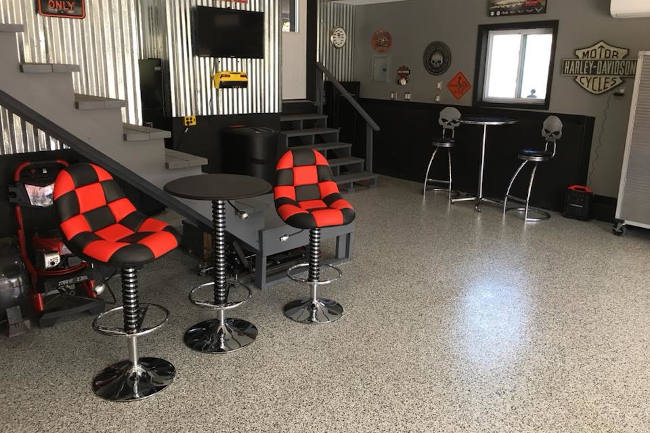 Before
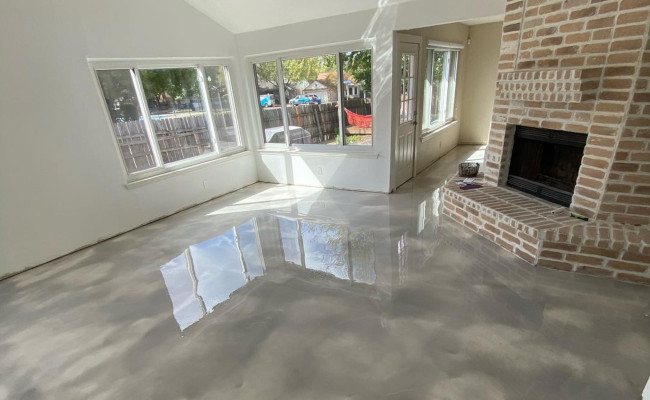 After
After
What a Coated Floor Does for a Pittsburgh Garage
Past the showroom gloss, here is what the system actually earns its keep on through a Western PA winter.
200°F+
Hot-Tire & Salt-Slush Resistant
Tires that crawled the Parkway East come home near 200°F and peel ordinary epoxy off in patches; the road brine they carry finishes the job at the door. A salt-rated polyaspartic top coat is built to take both the heat and the chloride.
Why Pittsburgh garage floors peel →0 stains
Spills Stay on Top
The oil change, the transmission drip, the road grime and de-icer washing off the undercarriage — none of it reaches the concrete. A sealed, non-porous floor gives every spill nowhere to soak in and a quick wipe to come up.
Safe
Grip When the Floor Is Wet
Snowmelt dripping off the bumper and slush off your boots turn a bare slab into a skating rink. Broadcast flake and an anti-slip additive in the top coat give you traction underfoot all winter, not a polished sheet of ice.
10–30 yrs
10-30 Year Lifespan
A professionally prepped and sealed floor clears a decade easily. Ground the slab right, test it for moisture, and finish with polyaspartic, and a Pittsburgh garage commonly runs 20 to 30 winters before it is due for a recoat.
Why coatings peel here →5 min
Salt Cleanup in Minutes
When the white salt rings dry on the floor in February, a mop and warm water lift them and the slab looks new again. No resealing, no waxing — a seamless surface with no joints or pores for grime to settle into.
Resale
A Selling Point at Showing
In a metro of older homes, a finished garage signals a slab that has been looked after — something buyers and agents flag the moment they walk in. It reads as care taken, not deferred, on the kind of detached or tuck-under garage Pittsburgh is full of.
See what sets the price →How It Works
Five steps from the first walk-through to a cured floor — sequenced around testing an older Allegheny County slab before a drop of resin goes down.
Free Consultation
~45 minWe visit your Pittsburgh garage, measure the space, assess slab condition, and discuss coating options. You will leave with a written quote, not a vague estimate. Schedule yours free.
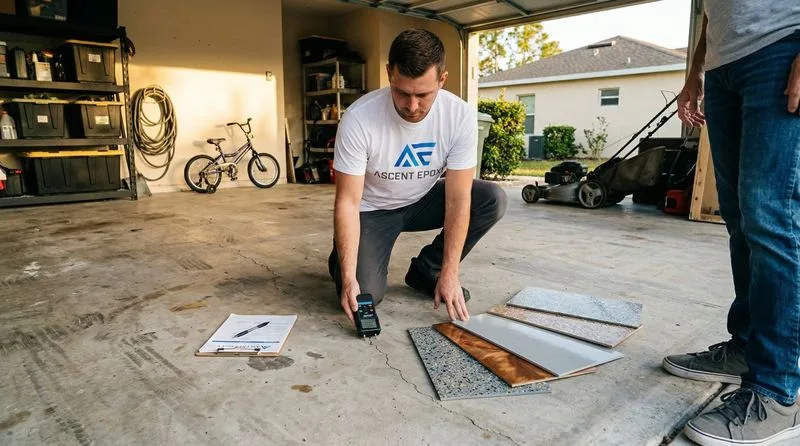
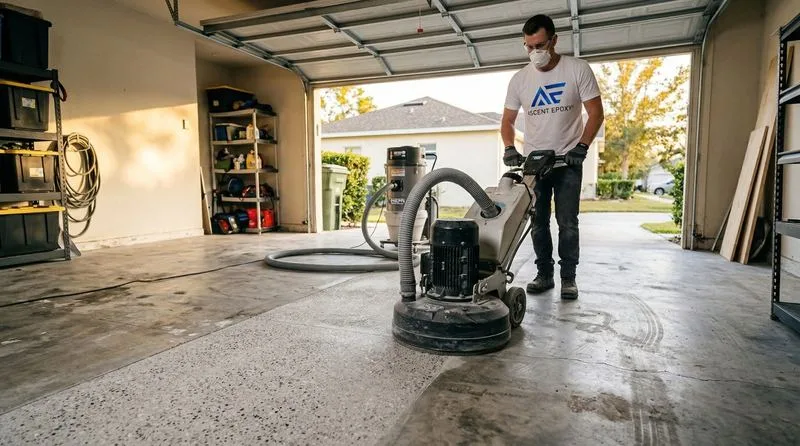
Surface Preparation
2–4 hrsDiamond grinding removes the top layer of concrete, opening pores for maximum epoxy adhesion. Calcium chloride and relative humidity moisture testing belongs in this step too, which is critical in Pittsburgh's climate.
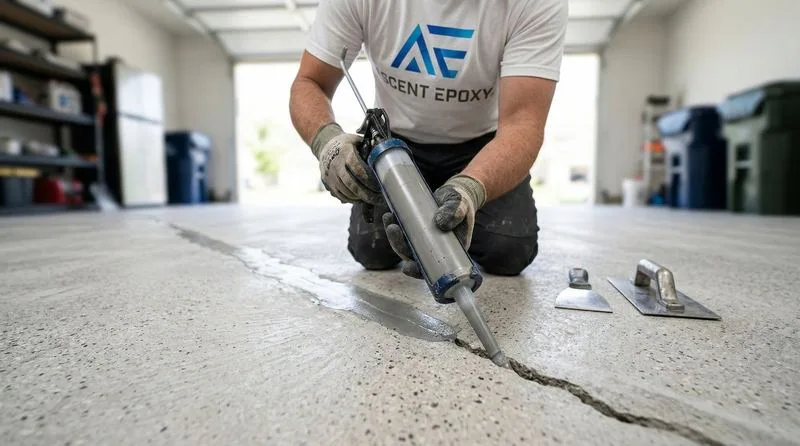
Crack & Joint Repair
30–60 minCracks, spalls, and control joints are filled with semi-flexible polyurea filler. This prevents cracking from telegraphing through the epoxy topcoat over time.
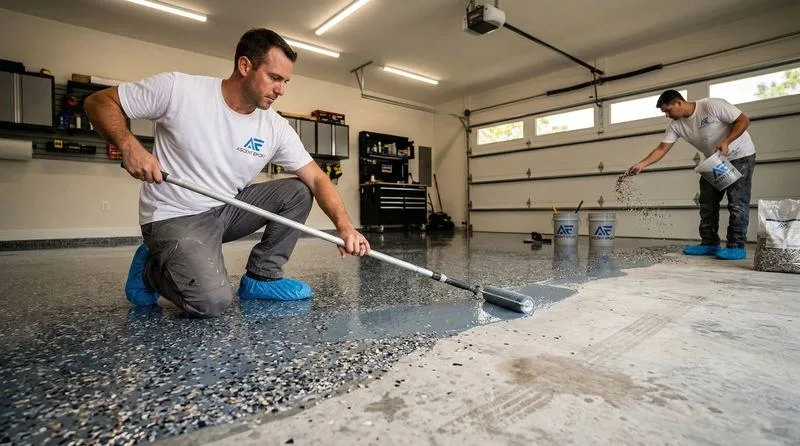
Multi-Coat Application
3–5 hrsWe apply a moisture-mitigating primer (when needed), a high-solids epoxy base coat with broadcast flake or metallic pigment, and a salt-rated polyaspartic topcoat for maximum durability and hot-tire resistance.
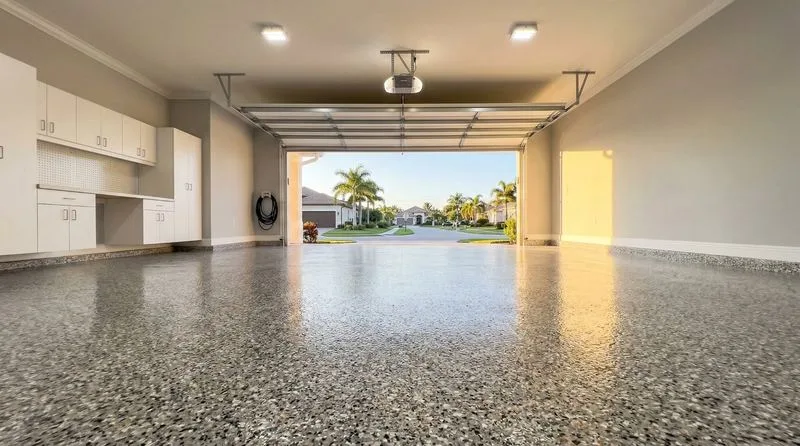
Cure & Enjoy
5–7 daysLight foot traffic is safe within 24 hours. Full vehicle traffic after 5 to 7 days of curing. We will walk you through care instructions.
Ready to Start? Step 1 Is Free.
Schedule your no-obligation consultation and see finish samples in your space.
Garage Finishes & Colors for Pittsburgh
Epoxy is no longer one flat gray. Three finish systems for a Western PA garage, in the look you want.
Why It Holds Up Through a Pittsburgh Winter
An epoxy body coat under a polyaspartic seal is about the toughest finish you can bond to concrete — and that toughness is what carries an older slab through 10 to 30 years of salt, freeze-thaw, and daily use.
Hot-Tire Resistant
Tires hot off a long Parkway run sit on the coating without grabbing it and tearing it loose — the single most common way a discount floor lets go. A polyaspartic seal is rated for that load.
Chemical & Salt Resistant
Road de-icer, oil, gas, antifreeze, brake fluid — the chloride and chemistry a Western PA winter drags in stay on top of a seamless surface and wipe away, instead of etching and staining the bare concrete underneath.
Freeze-Thaw Stable
A flexible polyurea fills the cracks and a polyaspartic seal moves with the slab as it swells and contracts through 65 freeze-thaw cycles, so the floor does not split or shed at the joints the way a rigid coating does.
Impact & Abrasion Resistant
A dropped socket, a rolling floor jack, a snow shovel scraped across it — the high-strength resin takes the daily knocks of a working garage without chipping. It is the same chemistry running on the region's shop and warehouse floors.
Tested for Old-Slab Moisture
On a pre-vapor-barrier slab — common under the city's older detached and tuck-under garages — ground moisture pushes up and lifts coatings from below. ASTM testing before quoting, and a vapor-barrier primer when the reading is high, is how a proper install stops that.
Easy to Clean & Maintain
Salt rings, sand, road grit, melt-water — a push broom and a damp mop clear all of it off a pore-free, jointless surface. No sealing or refinishing on the calendar, just the occasional wipe-down through the seasons.
The Five Steps a Pittsburgh Slab Needs
A disciplined sequence — built around reading an older slab for moisture first, so the floor that goes down lasts 10 to 30 years.
Free on-site consultation & estimate
We come to your Pittsburgh property to measure, inspect the slab, identify cracks or moisture issues, and discuss finish options. You get a written estimate — no surprise charges later.
Moisture testing & surface preparation
ASTM F1869 calcium chloride and F2170 relative humidity testing on the slab. Diamond grinding to open the concrete pores for maximum adhesion. Crack repair, joint treatment, and moisture mitigation primers where needed.
Base coat installation
High-solids 100% epoxy base coat applied to the prepared substrate. Color, flake, or metallic media added during this stage. Strict environmental control — substrate held above dew point throughout curing.
Polyaspartic top coat
UV-stable polyaspartic clear coat — the critical layer that resists yellowing, hot-tire pickup, and daily wear. This is what makes a floor last 20+ years through Pittsburgh's freeze-thaw cycles.
Final inspection
Walk-through with you. Light foot traffic in 24 hours, parking in 5–7 days, full cure in 7 days.
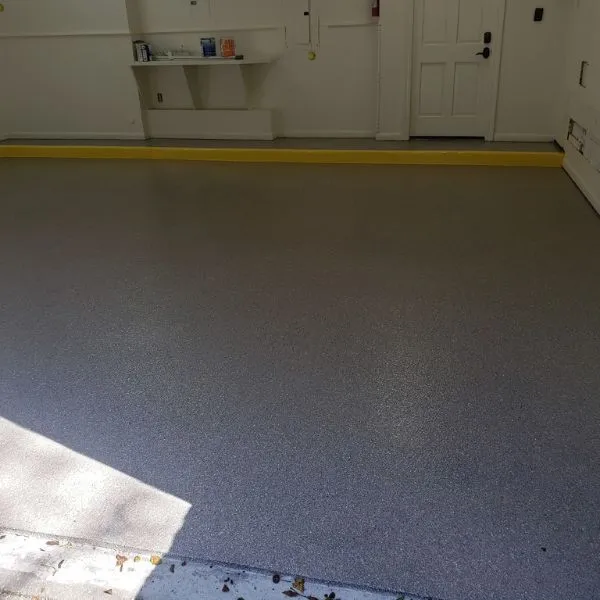
Garage Floor Finishes Around Pittsburgh
Floors like the ones we install in garages across Allegheny County and the surrounding boroughs.
Rated 5.0★ — Pittsburgh Reviews
Verified Google reviews from homeowners here in the Pittsburgh metro.
"We are thrilled with our new garage flooring! The team was professional and courteous throughout the entire installation process."
"Got my garage done this spring—smooth surface, no peeling, and it still looks brand new after months of use."
"Great local company. They helped us pick the right color flakes and the floor came out better than we imagined."
Garage Epoxy FAQs — Pittsburgh
Answers to the most common questions Pittsburgh homeowners ask about garage floor epoxy.
Every garage in Pittsburgh is priced after a free on-site estimate, because the price depends on the size of the space, the condition of the slab (cracks, old coatings, moisture), the coating system you choose (solid color, decorative flake, or metallic), and the prep the concrete needs, such as crack repair or moisture mitigation. Call (412) 388-9880 or request a free estimate for an exact price, with no obligation. See our full Pittsburgh cost guide for what moves the price.
Pittsburgh's 65 freeze-thaw cycles a year and 80%+ winter humidity inversions make moisture testing and proper surface preparation critical for a lasting garage epoxy floor. Excess moisture trapped in the concrete slab can cause epoxy coatings to bubble, peel, or delaminate within months of installation. Professional installers use calcium chloride testing and in-situ ASTM F2170 relative humidity probes to verify that slab moisture levels are within acceptable ranges before applying any coating. When moisture levels are elevated, a moisture-mitigating primer is applied first to create a vapor barrier between the slab and the epoxy system.
Garage epoxy floors in Pennsylvania last 10 to 30 years when installed with proper surface preparation and moisture testing. The wide range depends on the coating system used, the quality of prep work, and how the garage is used. High-solids epoxy base coats paired with polyaspartic topcoats deliver the longest service life because they resist UV salt damage, hot-tire pickup, and chemical exposure better than entry-level systems.
Yes, you can park on your new epoxy garage floor after a 5 to 7 day full cure period. Light foot traffic is typically safe within 24 hours of the final coat, and you can place objects on the surface after 48 to 72 hours. Professional-grade epoxy and polyaspartic topcoats are specifically formulated to resist hot-tire pickup, so you will not see marks or peeling from parking warm vehicles on the surface.
October through April is the best time to epoxy a garage floor in Pittsburgh. Lower humidity and cooler temperatures during these months create ideal conditions for epoxy adhesion and curing. Concrete surface temperatures between 50°F and 90°F are optimal for most epoxy systems. Summer installations are still possible but require additional climate control measures, such as dehumidifiers and fans, to manage moisture and heat during the application and cure stages.
Design your garage floor in 60 seconds.
Pick your size, finish, and color. See a real preview and your Pittsburgh price range before you call.
Open Floor Studio →