Epoxy Floor Repair Pittsburgh — Recoat the Floors That Run Our Hospitals, Labs & Mills
A UPMC service-corridor or imaging-suite coating lifting where the carts turn? A Mon Valley fab-shop floor cratering under forklift traffic? An Allegheny County basement slab that blistered the first winter, or a garage apron chipping off at the door from road-salt drag? Pittsburgh floors fail for reasons that are pure Western PA — freeze-thaw working the slab, PennDOT brine eating the edges, and pre-1970 concrete poured with no vapor barrier. We trace why yours failed, fix the slab, and re-topcoat it to hold. Free assessments across Allegheny, Westmoreland, Washington, Butler, and Beaver counties.
Why Pittsburgh Floors Fail — and How an Epoxy Floor Repair in Pittsburgh Makes the Recoat Hold
Pittsburgh runs on an eds-and-meds-and-mills economy, and every one of those sectors sits on a coated slab that can't go down. The UPMC system and the hospital network need imaging suites, lab floors, and service corridors that stay seamless and washable. The Oakland university belt around Pitt and CMU runs research labs, machine shops, and parking structures around the clock. Down the Mon Valley and out the Marcellus industrial belt, fab shops, metal-finishing plants, and warehouses put forklifts and pallet jacks on the floor every shift. When the coating in any of those spaces starts peeling at a doorway, blistering off a lab floor, or cratering where a lift turns, the operation can't just shut down and live with it — and neither can the homeowner whose Allegheny County basement or garage coating let go the first hard winter.
The reasons floors fail here are specific to Western Pennsylvania, not the coast. Pittsburgh takes roughly 65 freeze-thaw cycles a year: water works into the slab, freezes, and pries a rigid film loose from the edges and control joints. Then PennDOT lays down on the order of 600,000 tons of road salt a season, and that chloride brine gets tracked into garages and loading bays where it sits against the coating and undercuts the bond. On top of that, the median Allegheny County home was poured in 1954, before a vapor barrier was code — so groundwater pushes moisture vapor up through pre-1970 basement and garage slabs year-round. Drop a coating onto any of that without testing it, or skip the diamond grind to win the bid, and the bond fails from underneath in a season or two.
Then there's the everyday wear we simply resurface: hot-tire lift where a car sits on a garage slab after a drive, scuffing and pallet-jack ruts on a distribution floor, gouges at a loading dock, and topcoats worn dull in a high-traffic hospital or retail corridor. Flood a fresh coat straight over that and it peels right back on the same schedule. There's also one failure unique to this region worth checking for — cracks from mine subsidence, since roughly 230,000 Allegheny County homes sit over abandoned coal-mine workings; that's slab movement, not a coating problem.
So we read the floor before we quote it. We figure out whether you're looking at freeze-thaw edge lift, a salt-driven delamination, vapor blistering off an un-barriered slab, hot-tire pickup, a prep failure where the coating never keyed in, or a worn topcoat that only needs refreshing — then we match the repair to the cause. Failed and delaminated zones get ground back to sound concrete (we adjust our grind heads for Pittsburgh's hard slag-aggregate mix), a moisture-mitigation primer goes down when the slab calls for it, and we re-topcoat with a salt-rated polyaspartic spec'd for freeze-thaw and PennDOT brine — not whatever was cheapest on the truck.
What We Actually Repair on Pittsburgh Floors
From UPMC service corridors to Mon Valley shop floors to Mt. Lebanon basements — we match the fix to how the slab failed and how the room gets used.
Salt + freeze
Threshold & Salt-Edge Repair
Road salt tracks into garages and loading bays and freeze-thaw pries the coating off the edge first. We grind back the salt-undercut zone, re-profile, and wrap it in a chloride-rated polyaspartic that holds through a PennDOT winter.
Why floors peel at the door →Pre-1970
Basement-Slab Blister Repair
Pittsburgh's older housing stock means basement and garage slabs poured before vapor barriers were code. When that groundwater vapor blisters a coating off, we install a moisture-mitigation primer that seals the slab before we re-topcoat.
Hospital / lab
Clinical & Lab Floor Resurface
UPMC-network facilities, university research labs, and clinics need a seamless, washable surface back in service fast. We resurface failed medical and lab floors with chemical-resistant systems and stage the work around the schedule the room actually runs on.
Shop / dock
Forklift & Loading-Dock Spot Repair
Mon Valley shop floors and Marcellus-belt warehouses don't need a full redo for one bad patch. We spot-grind and rebuild forklift ruts, pallet-jack scuffing, and gouged dock edges at a fraction of a tear-out — without taking the whole bay offline.
Seasonal
Winter-Season Maintenance Plans
The salt season is what shortens a Pittsburgh floor's life. Our plans schedule a pre-winter inspection, salt-residue cleaning guidance, and spring touch-ups — catching freeze-thaw edge lift before it spreads across the slab.
Recoat < redo
Recoat Before You Tear Out
A sound slab almost never needs to come out. Resurfacing and re-topcoating a Pittsburgh floor runs far less than a full tear-out and re-pour — we give you an honest read on what yours actually needs before you spend a dollar.
See what sets the price →Salt-Edge Threshold Protection — A Named Fix for the Spot That Fails First
On a garage, shop, or loading-bay floor, the door threshold is where a Pittsburgh coating gives out first: salted snow piles against the opening, freeze-thaw works the edge, and the film chips off at the slab line. We productized the repair so that one weak spot doesn't take the rest of the floor with it.
- Diamond grind to CSP-3 across the salt-undercut threshold zone — a deeper mechanical profile than any acid etch.
- Polyaspartic edge wrap carried up the door track and out onto the apron where the brine actually sits.
- Chloride-rated topcoat selected for PennDOT road-salt exposure and freeze-thaw, not a generic big-box epoxy.
How It Works
A tested, repeatable process that addresses the cause of failure — not just the cosmetics.
Free Assessment
~45 minWe visit your Pittsburgh property, inspect the existing coating, and document the type and extent of failure. No cost, no obligation. Schedule yours free.
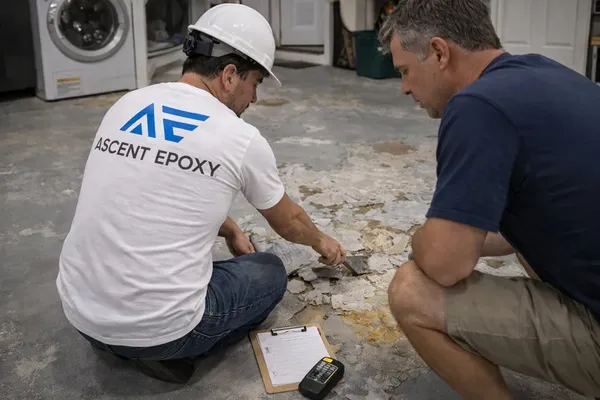
Diagnosis & Testing
1–2 hrsWe perform calcium chloride moisture testing, adhesion tests, and material analysis to pinpoint the root cause — MVT, poor prep, incompatible chemistry, or a combination.
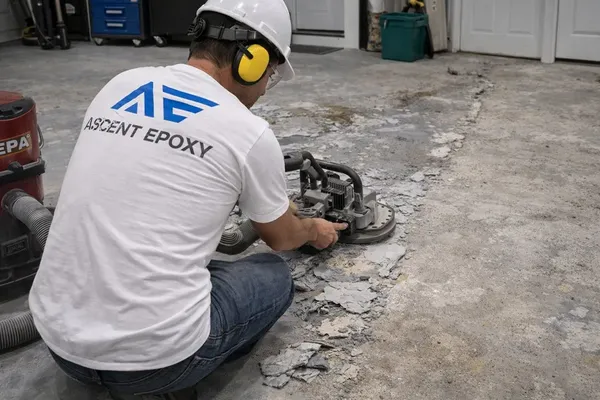
Surface Preparation
2–4 hrsDepending on the diagnosis, we either scarify the existing surface or fully strip the old coating down to bare concrete using diamond grinding. If moisture mitigation is needed, it is installed at this stage.
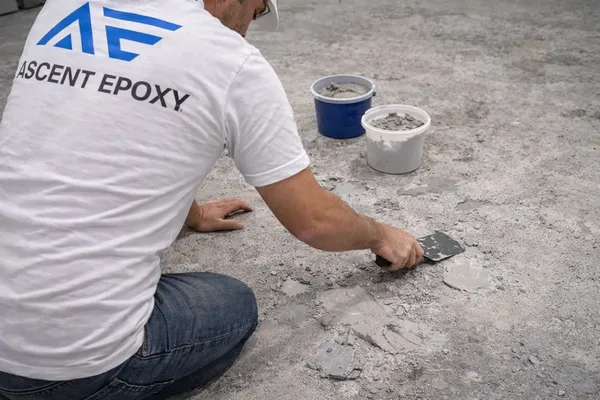
Repair & Re-Coat
3–5 hrsWe fill cracks, patch damaged areas, and apply the appropriate coating system — selected specifically for your slab conditions and Pittsburgh basement moisture levels.
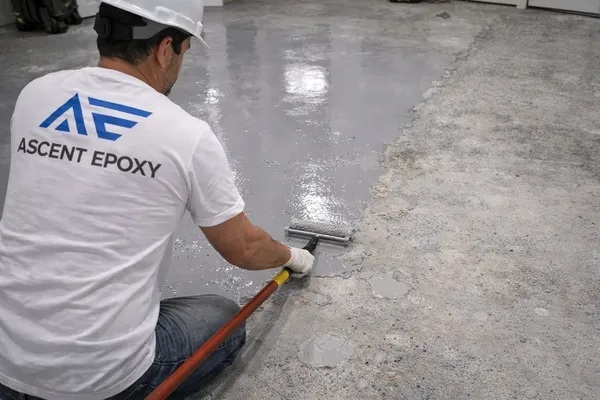
Cure
24–72 hrsWe manage cure times around Pittsburgh's temperature and humidity.
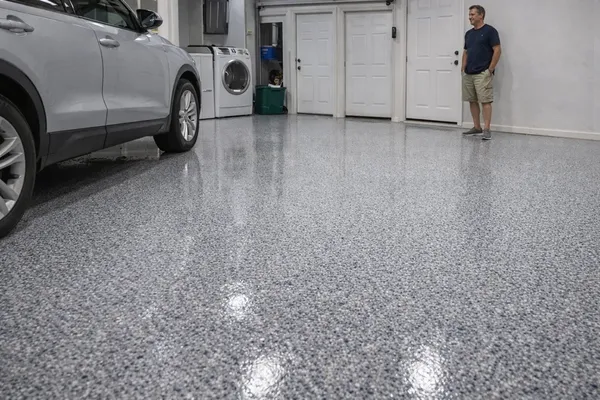
Ready to Start? Step 1 Is Free.
Schedule your no-obligation consultation and see finish samples in your space.
Match the Recoat to Your Original Finish — or Upgrade It
A resurface doesn't lock you into the look you had. When we re-topcoat a Pittsburgh floor, you can match the existing finish or move up to one of these three systems — each spec'd to hold through freeze-thaw and road salt.
What a Properly Repaired Pittsburgh Floor Stands Up To
Once we fix the root cause and re-topcoat it right, the restored surface earns back the properties the failed coating lost — the ones that matter through a Western PA winter.
Freeze-Thaw Edge Stable
The repaired edge no longer lifts when 65 freeze-thaw cycles a year work the slab. The flexible re-bond and polyaspartic wrap move with the concrete instead of cracking off at the joint.
Road-Salt & Chemical Resistant
Tracked-in PennDOT brine, road grime, oil, brake fluid, antifreeze, and shop chemicals wipe up off the sealed surface — the chloride that undercut the old coating has nowhere to soak in on the recoat.
Hot-Tire Lift Solved
The classic bargain-epoxy failure — a warm tire pulling the film off where the car parks — doesn't come back. The polyaspartic recoat grips through hot-tire contact instead of releasing with it.
Forklift & Impact Rated
Built back to take what failed it — pallet-jack and forklift traffic on a Mon Valley shop floor, dropped tools, and wheeled equipment — without chipping again. The same high-build resin we spec for industrial slabs.
Vapor-Tested on Old Slabs
Re-bonded to a moisture-tested, primed slab, the recoat resists the vapor pressure that blistered it off a pre-1970 Pittsburgh basement floor. That is why ASTM moisture testing belongs before any re-topcoat.
Winter-Easy to Clean
Salt slurry and slush mop straight off the seamless recoat — no grout lines, no porous concrete for chloride to sit in. A push broom and a rinse keep a Pittsburgh garage or shop floor sound through the season.
The Recoat System We Rebuild Your Floor With
Once the failed coating is off and the slab is sound, this is the five-layer system that goes back down — spec'd for Pittsburgh freeze-thaw and PennDOT salt, not a one-day big-box kit.
Failure diagnosis & written estimate
We come to your Pittsburgh property, read why the old coating failed — salt-edge lift, vapor blister, hot-tire pickup, or prep failure — and scope whether it's a spot repair or a strip-and-recoat. You get a written estimate, no surprise charges later.
Strip, moisture-test & re-profile
Failed coating ground off, then ASTM F1869 calcium-chloride and F2170 relative-humidity testing on the bare slab. We diamond-grind the hard slag-aggregate concrete to a clean profile, rout and fill cracks, and lay a moisture-mitigation primer where an old basement slab calls for it.
Re-bond the base coat
A high-solids 100% epoxy base coat keyed into the freshly profiled slab, blending the repaired zones into the field so there's no visible seam. Color, flake, or metallic media goes in here. Substrate held above dew point the whole time — no cold-slab installs.
Salt-rated polyaspartic top coat
A chloride-rated, UV-stable polyaspartic clear coat — the layer that resists the road salt and hot-tire pickup that took the last coating down, carried up the threshold edge where Pittsburgh floors give out first.
Cure & walkthrough
We manage cure around Pittsburgh slab temperatures and walk the repaired floor with you. Light foot traffic in 24 hours, parking in 5–7 days, full cure in 7 days.
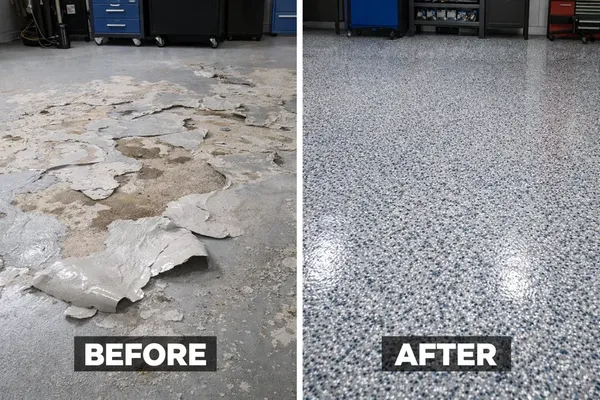
Recoat & Resurface Jobs Around Pittsburgh
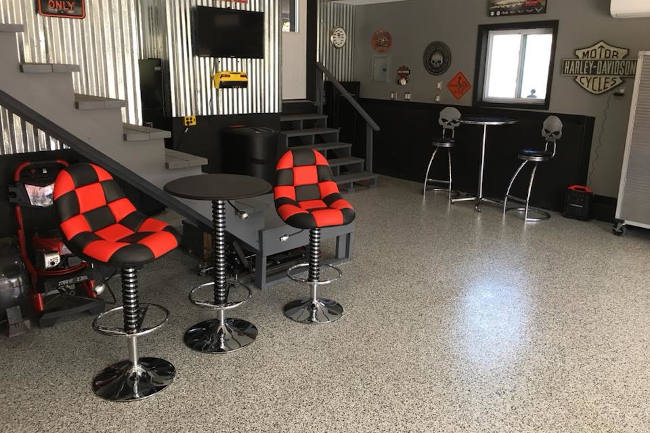
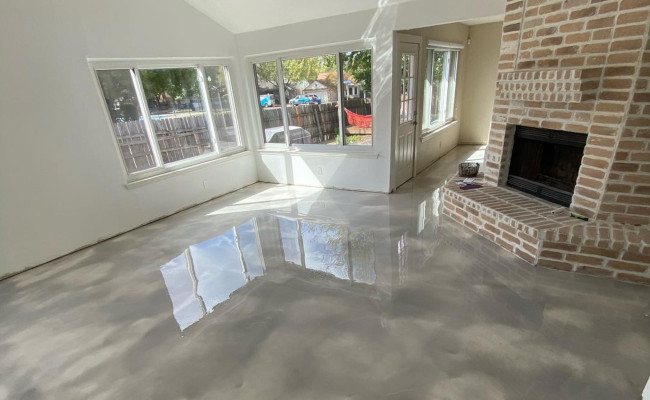
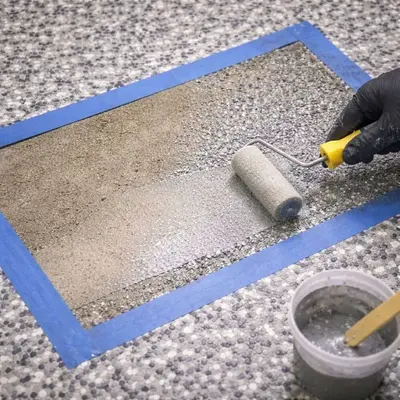
Before-and-after examples like the repair and recoat work we do across Allegheny County and the surrounding region.
Rated 5.0★ — Pittsburgh Reviews
Real reviews from real Pittsburgh homeowners — verified on Google.
"We are thrilled with our new garage flooring! The team was professional and courteous throughout the entire installation process."
"Got my garage done this spring—smooth surface, no peeling, and it still looks brand new after months of use."
"Great local company. They helped us pick the right color flakes and the floor came out better than we imagined."
Epoxy Repair FAQs — Pittsburgh
Common questions about epoxy floor repair and maintenance in Pittsburgh.
Pennsylvania's extreme humidity and moisture vapor transmission (MVT) through concrete slabs are the number one cause of epoxy failure in Pittsburgh. When installers skip proper moisture testing or use coatings incompatible with high-moisture environments, the bond between epoxy and concrete weakens. Moisture trapped beneath the coating creates hydrostatic pressure that causes peeling, bubbling, and delamination.
Post-flood slabs and older homes without modern vapor barriers are especially vulnerable. A slab should be tested for moisture before any repair strategy is chosen.
It depends on the condition of the existing coating and the underlying concrete. In some cases, we can scarify the surface and apply a new system directly over the old one. However, if the previous coating is severely delaminated, contaminated, or applied over untreated moisture issues, a full strip-down to bare concrete is necessary for a lasting repair.
We perform on-site testing to determine the right approach for your specific floor — no guesswork.
Costs vary depending on the scope of damage, square footage, whether a full strip is needed, and if moisture mitigation is required. Spot repairs start significantly lower than full re-coats. In many cases, repair is a fraction of the cost of a complete new installation.
We provide free on-site assessments so you get an exact price before any work begins, with no obligation. See our Pittsburgh cost guide for what moves the price.
Yes. Many Pittsburgh slabs with chronic moisture issues experience coatings that fail repeatedly. The answer is high-moisture slab preparation, including calcium chloride moisture testing, moisture mitigation systems, and coatings specifically engineered for high-MVT environments.
Our process addresses the root cause so your new coating bonds permanently instead of peeling again within months.
Yes. We offer ongoing maintenance plans that include periodic inspections, cleaning guidance, minor touch-ups, and re-coating schedules tailored to your floor's traffic level and environment. Maintenance plans help extend the life of your epoxy floor by years and catch small issues before they become costly repairs.
Contact us for a customized maintenance plan for your home or business.
Design your epoxy floor in 60 seconds.
Pick your size, finish, and color. See a real preview and your Pittsburgh price range before you call.
Open Floor Studio →