Commercial Epoxy Flooring Pittsburgh — Floors for an Eds-and-Meds Town
Western PA runs on hospitals, universities, and the shops that feed them — and every one of those floors is fighting tracked-in winter road salt. We coat restaurant kitchens, clinic exam rooms, retail showrooms, and office lobbies in phases or after-hours so your Pittsburgh business never goes dark for a week. Salt-rated polyaspartic, FDA/USDA-rated finishes, and ACHD-ready seams.
One Floor Built for Western PA's Eds-and-Meds Economy
Pittsburgh stopped being a one-industry town a generation ago. Today the region's largest employers are its hospital networks and universities, with a deep bench of advanced-manufacturing and machine shops carried over from the steel era. That mix shapes who walks into our commercial estimates: a clinic operator off the Oakland medical campus, a brewpub in Lawrenceville, a furniture showroom in the Strip District, a dealership service desk out in Monroeville. The common thread is a concrete slab taking constant punishment — and a floor that has to look the part for patients, diners, and buyers alike.
Where a commercial floor fails here has little to do with Sun Belt heat and everything to do with the calendar. From roughly November through March, customers and staff track in a slurry of snowmelt and chloride de-icer, and the slab below cycles above and below freezing again and again. That freeze-thaw movement and the salt riding on it are what lift cheap coatings at the door line and chew through unsealed concrete. We spec a salt-rated polyaspartic top coat and treat the entry zones as the hardest-working square footage in the building — because in Pittsburgh, they are.
The finish itself is what regulated rooms need. A multi-layer epoxy system bonds straight into the slab to form one monolithic membrane — no grout lines, no tile seams, nowhere for grease, road grit, or bacteria to settle. That seamless surface is what carries a Bloomfield kitchen through an Allegheny County Health Department inspection, and what lets a dental, veterinary, or outpatient suite near the university hospitals wipe down to a sterile state between patients. When the demand turns forklift-rated — a Mon Valley fabricator or a parts distributor — step up to our industrial epoxy flooring systems.
Pittsburgh's older building stock adds a wrinkle most markets skip. A lot of Pittsburgh commercial space sits in converted mill buildings, century-old storefronts, and structures with damp basements, where moisture pushing up through the slab will delaminate a coating that wasn't tested for it. That is why an ASTM moisture reading belongs on a commercial slab before a drop of resin goes down, with primer and mitigation matched to what the concrete is actually doing — not what a spec sheet assumes.
We coat the rooms where this economy runs day to day, not generic "businesses":
- Restaurants, bars, breweries, and commercial kitchens — Lawrenceville, the Strip, East Liberty, the South Side
- Retail floors and furniture or appliance showrooms
- Medical, dental, and veterinary clinics near the Oakland and university hospital campuses
- Offices, lobbies, and co-working buildouts downtown and along the tech corridor
- Hotel and hospitality back-of-house in the convention district
- Auto dealership service bays and detail floors out the eastern suburbs
Need a heavier-duty system for a warehouse or fabrication environment? See our industrial epoxy flooring page. For what sets the price of a commercial floor in the Pittsburgh market, walk through our cost guide.
What Pittsburgh Operators Actually Get Out of It
A floor that shrugs off winter salt, clears the health inspector, and stays open while we work — engineered for the way Western PA businesses run.
Phased
You Stay Open
We coat in sections and schedule around your hours — a restaurant gets the front of house overnight, an office gets the lobby on a weekend. Salt-rated polyaspartic returns the floor to service fast, so no shift gets cancelled.
FDA / USDA / ACHD
Clears the ACHD Inspector
Seamless, non-porous epoxy meets FDA and USDA food-contact guidelines, so a Strip District kitchen or an Oakland-campus clinic has no grout lines or cracks for bacteria to hide in — the difference between passing an Allegheny County Health Department visit and a re-inspection.
100+
Salt & Chemical Resistant
Chloride de-icer, grease, fryer oil, brake fluid, sanitizing chemicals — none of it stains or eats into the surface. The same chemistry that survives a winter of tracked-in road salt at the door shrugs off whatever a kitchen or service bay throws at it.
Safe
Traction When It's Wet
Anti-slip aggregate and textured topcoats keep footing sure in the exact spots that get dangerous here — the vestibule where boots drag in slush, the kitchen line, the loading entry. Helps meet OSHA requirements and cuts the winter slip-and-fall risk that climbs every time it snows.
10-20 yrs
10-20 Year Lifespan
Multi-layer commercial systems run 10 to 20 years with normal upkeep — long past what VCT tile or sheet vinyl survives in a building that swings through dozens of freeze-thaw cycles a winter. One install instead of replacing tile every few years.
Why slab moisture matters here →5 min
Five-Minute Cleanup
No waxing, no stripping, no specialty stripper for the salt residue that builds up all winter. A dust mop and a neutral cleaner pull up grit and chloride before it scratches — less labor for your closing crew and a floor that still photographs new in year ten.
See what sets the price →From Estimate to Open Doors
Five steps, built around your operating hours and Western PA's slab conditions.
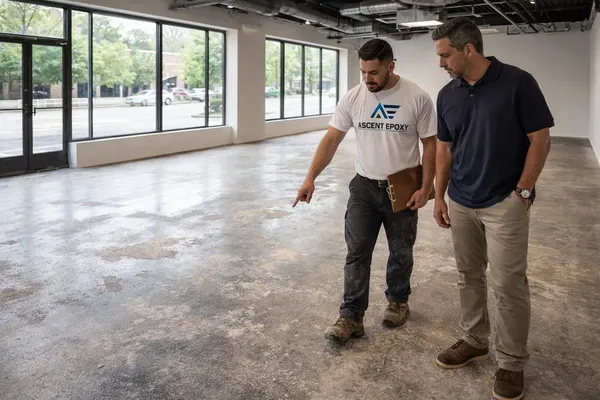
Consultation & Site Assessment
~45 minWe walk your space, read the existing slab — cracks, old tile, the door zones that take the winter salt — measure square footage, and map the busiest hours so the coating can go down around them. Schedule yours free.
Custom System Design
1–2 daysWe match the buildout to your industry — antimicrobial flake for an exam room, a sharp solid color for a showroom — spec'ing primer, base, anti-slip media, and a salt-rated topcoat. Bigger footprints get a section-by-section schedule so the doors never close.
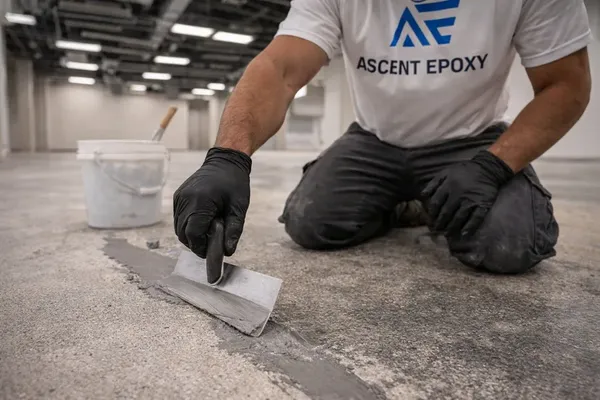
Surface Preparation
2–4 hrsWe diamond-grind and profile the concrete for a true mechanical bond, then repair the cracks and freeze-thaw spalling older Pittsburgh slabs collect. An ASTM moisture test is mandatory in converted mill buildings and basement-level spaces where vapor pushes up year-round.
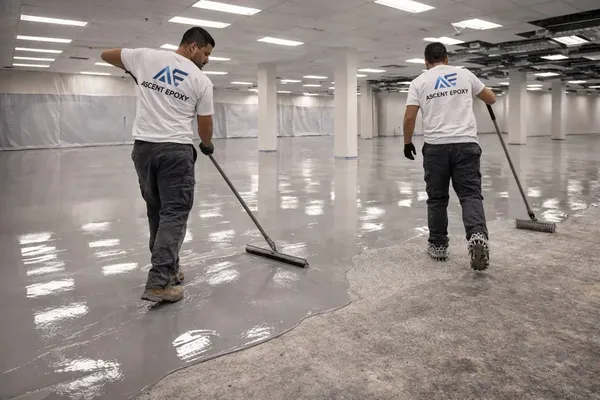
Multi-Layer Application
3–5 hrsDown go the primer, body coat, broadcast media (flake or metallic), then the salt-rated polyaspartic top coat that fends off chloride and hot foot traffic. On phased jobs we coat one section at a time so your staff keeps working the rest of the floor.
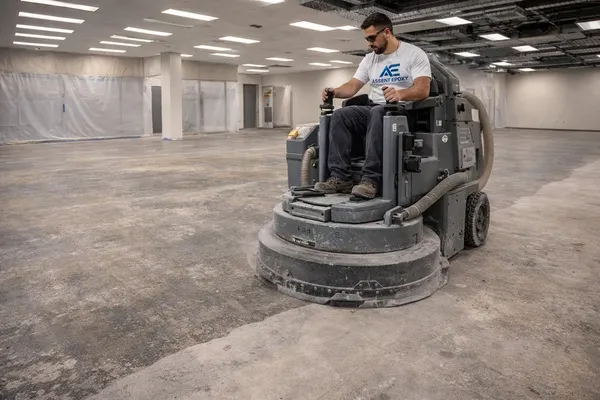
Final Walkthrough & Handoff
~1 hrWe walk the finished floor with you, verify adhesion and the topcoat, and hand over a care guide tuned to your operation — including how to keep winter salt from dulling the surface.
Ready to Start? Step 1 Is Free.
Schedule your no-obligation consultation and see finish samples in your space.
Finishes Matched to the Room — and the Brand
From a showroom that has to photograph well to a kitchen that has to drain and grip, three finish systems, each spec'd for the way the space gets used and the Pittsburgh winter it has to survive.
What the Floor Has to Survive Here
Western PA tests a commercial floor differently than the Sun Belt does. An epoxy + salt-rated polyaspartic system is built for the specific abuse a Pittsburgh business slab takes year-round.
Freeze-Thaw & Road Salt
The number-one killer of commercial floors here. Tracked-in chloride de-icer and a slab that cycles above and below freezing all winter lift cheap coatings at the entry — a salt-rated polyaspartic top coat is what stops it cold.
Chemical & Stain Resistant
Fryer oil, red wine, blood and disinfectant in a vet suite, brake fluid in a service bay — wipe it up and the floor underneath is unmarked. The seamless surface gives commercial spills nowhere to soak in.
UV-Stable
Bare epoxy ambers over time. Polyaspartic topcoats hold their color behind a storefront's south-facing glass or under a showroom's display lighting — the floor still matches the brand in year ten.
Impact & Abrasion Resistant
Pallet jacks, gurneys, rolling racks, and a steady stream of feet — the high-strength resin takes daily commercial pounding without chipping or wearing a path through the high-traffic lanes.
Handles Damp Slabs
Installed over a moisture-tested, mitigated slab, the system holds where lesser coatings peel — the converted mill buildings and basement-level commercial spaces all over Pittsburgh. That is why ASTM testing comes first.
Fast to Sanitize
No grout lines, no porous concrete to trap salt residue or biofilm. An exam room or kitchen line wipes down to a sterile state in seconds, and the closing crew clears the floor with a mop instead of a stripper.
The Install, Step by Step
A disciplined five-step sequence — the part that decides whether a Pittsburgh floor lasts two winters or twenty.
Free on-site consultation & estimate
We come to your Pittsburgh business, measure, inspect the slab for cracks and moisture, look at how foot and cart traffic moves through, and talk finishes. You leave with a written estimate — no surprise line items later.
Moisture testing & surface preparation
ASTM F1869 and F2170 readings on the slab before a system is chosen. Diamond grinding to open the pores, plus repair of the cracks and freeze-thaw spalling older Pittsburgh slabs carry. Moisture-mitigation primer goes down wherever the readings call for it.
Base coat installation
A high-solids 100% epoxy base bonded into the prepped slab, with color or flake broadcast in at this stage. We hold the substrate above dew point the whole cure — the discipline a damp Pittsburgh building demands.
Polyaspartic top coat
The salt-rated, UV-stable polyaspartic clear coat — the layer that fights chloride, yellowing, and daily commercial wear. This is what carries a floor 20+ years through Pittsburgh's freeze-thaw winters instead of failing at the door in two.
Final inspection
Walk-through with you. Light foot traffic in about 24 hours, carts and full operation by day 5–7, complete cure inside a week so you can plan the reopening.
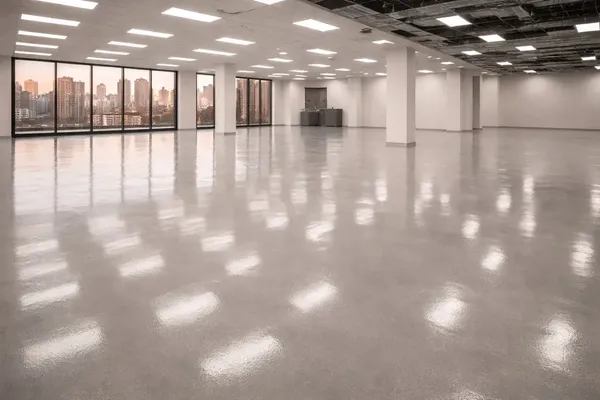
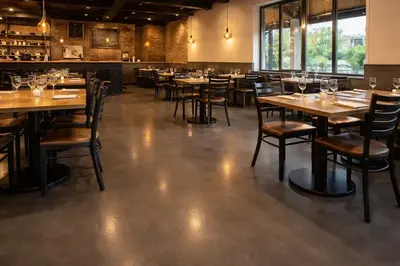
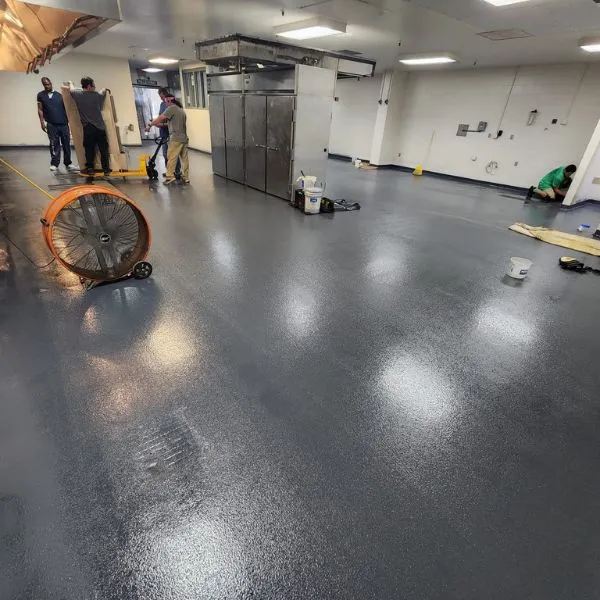
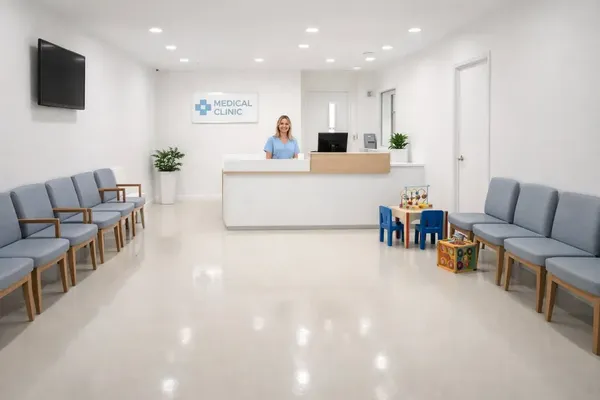
Commercial Floors Around the Region
Floors like the ones we install for restaurants, retail, offices, and service shops across Allegheny County and beyond.
Rated 5.0★ — Pittsburgh Reviews
Real reviews from real Pittsburgh customers — verified on Google.
"We are thrilled with our new garage flooring! The team was professional and courteous throughout the entire installation process."
"Got my garage done this spring—smooth surface, no peeling, and it still looks brand new after months of use."
"Great local company. They helped us pick the right color flakes and the floor came out better than we imagined."
Commercial Epoxy Flooring FAQ — Pittsburgh
Common questions from Pittsburgh business owners about commercial epoxy floor installation.
Every commercial floor in Pittsburgh is priced after a free on-site estimate, because the price depends on the size of your space, the condition of the existing concrete, the type of epoxy system required, and any specialized features like anti-slip aggregate or chemical-resistant topcoats. Larger commercial spaces often benefit from lower per-square-foot pricing due to economies of scale. Call (412) 388-9880 for a written quote, with no obligation.
For what moves the price by project type, see our Pittsburgh epoxy cost guide.
Yes, phased installation schedules keep your Pittsburgh business operational during the coating process. For restaurants, retail stores, and offices, we can work in sections — completing one area while you continue using the rest. We also offer weekend and after-hours installation to minimize impact on your daily operations.
Most commercial projects are completed within 3 to 5 days depending on square footage and system complexity.
Yes. Our commercial epoxy systems meet FDA and USDA guidelines for food-contact surfaces when properly installed and sealed. The seamless, non-porous finish prevents bacteria buildup and makes daily cleaning fast and effective — a major advantage for Pittsburgh restaurants navigating health code inspections.
We also offer antimicrobial additive options for commercial kitchens and food preparation areas that need an additional layer of protection.
Properly installed commercial epoxy flooring lasts 10 to 20 years in high-traffic Pittsburgh businesses. The lifespan depends on the type of traffic your space receives, the epoxy system thickness, and how well the floor is maintained.
Our commercial-grade systems use multi-layer applications with industrial topcoats designed to withstand heavy daily use without salt damage, peeling, or wearing through — even in Pennsylvania's humid conditions.
Yes. We serve the entire Pittsburgh metro area including commercial and industrial districts along I-79 and I-376.
We also serve Cranberry Township, Wexford, Murrysville, Mars, Mt. Lebanon, and communities across Allegheny County. Visit our service areas page for the full list.
Design your commercial epoxy floor in 60 seconds.
Pick your size, finish, and color. See a real preview and your Pittsburgh price range before you call.
Open Floor Studio →