Industrial Epoxy Flooring for Pittsburgh's Manufacturing, Marcellus & Warehouse Economy
Forklift-rated impact systems and OSHA-compliant safety striping — spec'd for hospital and lab support spaces, advanced-manufacturing and fabrication shops, food-and-beverage rooms, and distribution warehouses across Allegheny County. Built to survive Western PA freeze-thaw and winter road salt.
The Floors Behind Pittsburgh's Hospitals, Labs, Plants & Warehouses
Western Pennsylvania doesn't run on one industry, and its industrial floors don't either. The region's "eds-and-meds" economy — the UPMC and Allegheny Health Network hospital systems, plus the research footprint around the University of Pittsburgh, Carnegie Mellon, and Duquesne — fills a city with back-of-house spaces that have to stay clinically clean and stand up to washdown: central sterile-processing rooms, lab and pharmacy support areas, food-service commissaries, and equipment shops. None of those is served by the showroom-grade commercial epoxy flooring a lobby or retail bay uses.
Then there is the part of Pittsburgh that still makes things. The Mon Valley's steel heritage never fully left — it evolved into metals fabrication, machine shops, and the advanced-manufacturing and robotics work taking over old mill sites like Hazelwood Green and the Strip District. Layer on the food-and-beverage rooms behind the Strip's wholesale produce trade and the craft breweries scattered across Lawrenceville and the South Side, and the distribution warehouses fanning out along I-79, I-376, and the Turnpike toward the airport corridor, and you get a metro where one installer has to spec for everything from a 400-square-foot wash bay to a slab running past 50,000 square feet.
What ties it together is the climate the slab has to live through. Pittsburgh runs a hard freeze-thaw cycle — water seeps into concrete, freezes, and pries the surface apart over a long winter — and the road salt and brine tracked in on forklifts, pallets, and fleet tires through the PennDOT salting season chews at coatings and corrodes joints and dock edges. Much of the city's industrial space also sits in older brick-and-timber building stock with below-grade slabs and basements, where moisture drives up through the floor year-round. So we grind to a clean profile, run probe and calcium-chloride moisture readings across the whole slab, repair the freeze-cracked joints, and pour vapor-mitigated systems built to take salt without lifting.
Need a solution for a retail, office, or hospitality space instead? See our commercial epoxy flooring service.
What a Pittsburgh Industrial Floor Has to Survive
Freeze-thaw cracking, tracked-in road salt, washdown chemistry, and round-the-clock loads — the coating is spec'd to the room and the substrate, not pulled off a shelf.
100+
Chemical & Acid Resistant
From the cutting fluids and solvents on a Mon Valley fabrication floor to the cleaning acids and disinfectants in a hospital sterile-processing room and the brewing chemistry in a Lawrenceville taproom, we match the resin to the room.
10,000+ lbs
Forklift & Heavy Machinery Rated
The distribution warehouses along the I-79 and I-376 corridors and the machine shops across the Mon Valley never really stop — reach trucks pivot on the same turns and racking drives tons onto a few square inches. Our build takes that constant impact and abrasion without cracking, chipping, or delaminating, shift after shift.
OSHA
Meets OSHA 1910.22 — Walking-Working Surfaces
A hosed-out food commissary, a salt-and-slush entry where fleet tires track in off a Pittsburgh winter, a humid below-grade threshold — the places a slab here turns slick are exactly the ones OSHA watches. Non-slip textures and anti-skid aggregate keep traction underfoot and keep your facility compliant on every square foot.
Custom
Safety Line Marking
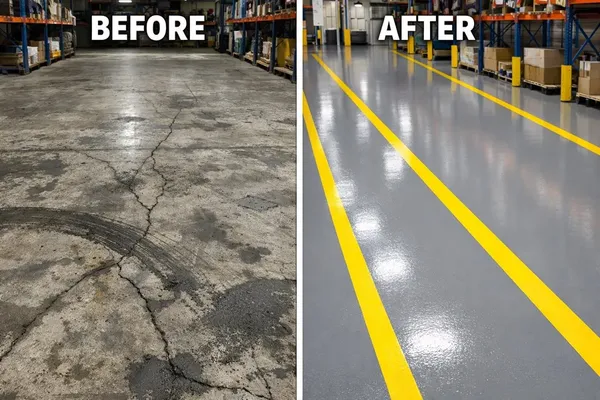
Aisle lanes, pedestrian paths, staging grids, dock-edge color coding, and hazard zones striped right into the system — laid out the way a high-throughput airport-corridor distribution floor or a Mon Valley fabrication shop needs to run. Durable epoxy markings that withstand heavy daily traffic without fading.
10–20 yrs
10–20 Year Performance
Done right — the freeze-cracked joints repaired, the slab ground and moisture-tested, and a vapor-mitigated system poured — an industrial floor delivers 10 to 20+ years of continuous service under forklifts, washdowns, and chemical load. That's decades on a Western PA slab without costly resurfacing.
How freeze-thaw affects durability →How It Works
Five steps from a freeze-stressed slab to a fully cured, production-ready floor. Phased installation available so a hospital support wing, a Mon Valley plant, or a Strip District commissary keeps operating while we work.
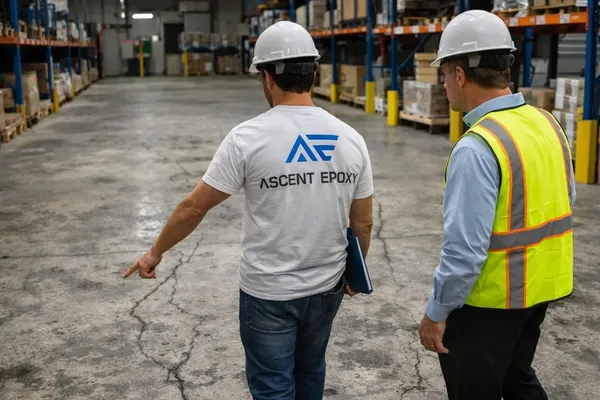
Facility Assessment
~Half dayWe survey the entire facility, test slab moisture levels across multiple zones, log the freeze-cracked joints and curled corners, identify chemical exposure requirements, and map forklift and traffic patterns. Schedule yours free.
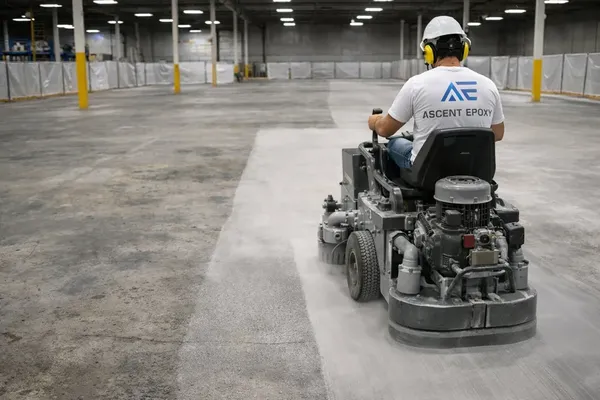
Industrial Slab Preparation
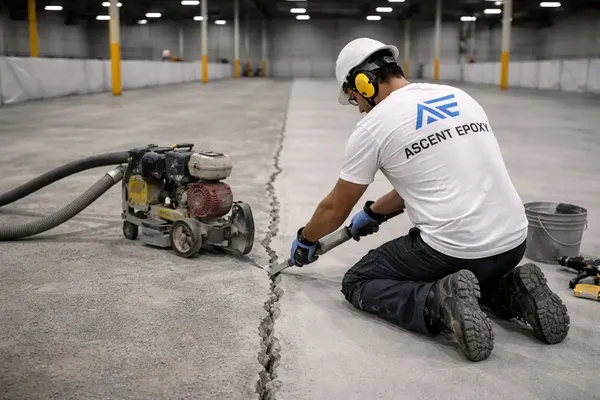
4–8 hrsDiamond grinding and shot blasting across the full surface to cut a proper adhesion profile. The freeze-thaw cracks, spalled patches, and worked joints get treated first — repaired with load-bearing fillers so the coating doesn't fail the next time the slab cycles through a Pittsburgh winter. Extended prep on large slabs means no zone is missed.
Primer & Moisture Barrier
2–4 hrsIndustrial-grade primer that seals the slab and chemically bonds the concrete to the system above it. Vapor-mitigation coatings go down wherever moisture testing reads high — a frequent issue on the below-grade slabs and basements common in Pittsburgh's older industrial building stock, where ground moisture drives up through the floor.
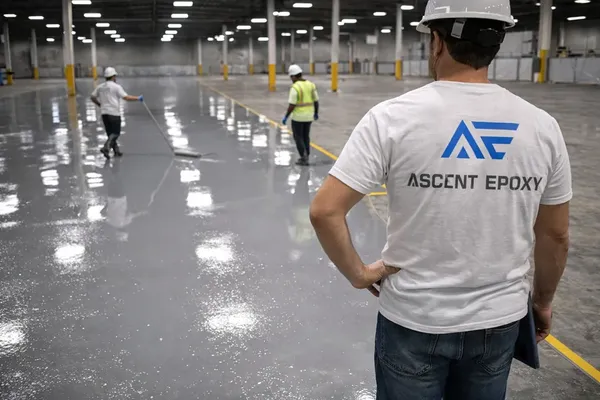
Epoxy System Application
1–3 daysThe build is matched to the room: impact-rated systems for round-the-clock warehouses and high-traction sealers for fleet and maintenance bays. Safety striping, color-coded zones, and anti-slip aggregate go in during this phase.
Curing & Handoff
3–7 daysA controlled cure with temperature and dew-point monitoring — the step that matters most when a Pittsburgh slab is still shedding winter cold. We check hardness, adhesion, and chemical resistance, then walk your crew through upkeep guidelines written for your specific coating and facility.
Ready to Start? Step 1 Is Free.
Schedule your no-obligation consultation and see finish samples in your space.
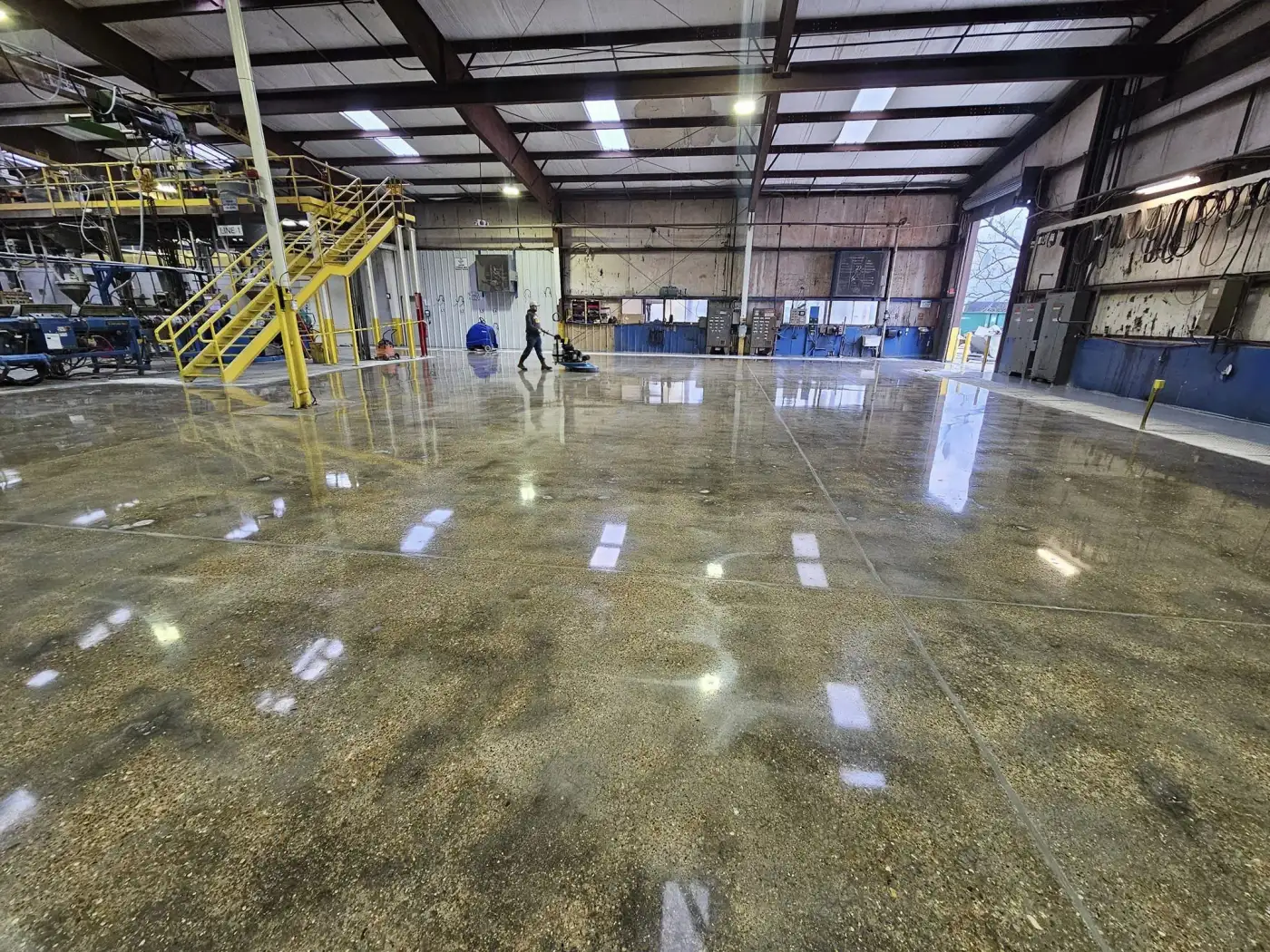
Industrial Epoxy Projects
Floors like the ones we install in Pittsburgh warehouses, fabrication shops, and processing rooms.
Rated 5.0★ — Pittsburgh Reviews
Real reviews from real Pittsburgh clients — verified on Google.
"We are thrilled with our new garage flooring! The team was professional and courteous throughout the entire installation process."
"Got my garage done this spring—smooth surface, no peeling, and it still looks brand new after months of use."
"Great local company. They helped us pick the right color flakes and the floor came out better than we imagined."
Industrial Epoxy Flooring FAQs — Pittsburgh
Common questions about industrial epoxy flooring for Pittsburgh facilities.
We install industrial epoxy flooring in a wide range of facilities across the Pittsburgh metro area, including:
- Warehouses and distribution centers
- Manufacturing plants
- Chemical processing facilities
- Food and beverage processing plants
- Maintenance bays and service shops
- Control rooms and clean environments
Our systems are engineered to handle the specific demands of each facility type, from chemical resistance in processing plants to impact resistance in high-traffic warehouses.
Pittsburgh's average winter humidity inversions is critical for large industrial slabs. Moisture trapped beneath the coating causes delamination and peeling, and on expansive warehouse floors, even small moisture variations can affect thousands of square feet.
We perform comprehensive moisture testing across the entire slab using calcium chloride and relative humidity probe methods. When readings are elevated, we apply moisture-mitigating primers and vapor barrier coatings before the epoxy system goes down. We also schedule installation windows around optimal humidity conditions to ensure a lasting bond.
Yes. Our industrial epoxy systems are formulated with chemical-resistant resins that withstand exposure to a wide range of substances, including acids, alkalis, solvents, petroleum products, oils, and fuels.
We offer various chemical resistance ratings depending on the specific chemicals present in your facility. Standard epoxy handles oil, grease, and mild chemicals.
Yes. We install OSHA-compliant safety line marking as part of our industrial epoxy flooring systems. This includes:
- Pedestrian walkways
- Forklift traffic lanes
- Hazard zones and restricted areas
- Equipment placement boundaries
- Emergency exit paths
- Color-coded area designations
All markings are applied with durable epoxy paint that bonds directly to the floor system and withstands heavy daily traffic without fading or peeling.
Industrial epoxy installation typically takes 3 to 7 days depending on the facility size, condition of the existing concrete slab, and complexity of the coating system required.
For larger facilities, we offer phased installation that allows you to keep portions of your operation running while we work on other sections. This minimizes downtime and keeps your production schedule on track. We provide a detailed project timeline during the estimate phase so you can plan around the installation.
Spec your facility floor in 60 seconds.
Enter your square footage and the demands on the slab — chemicals, forklifts, washdown — and get a preview plus a Pittsburgh estimate range before you ever pick up the phone.
Open Floor Studio →