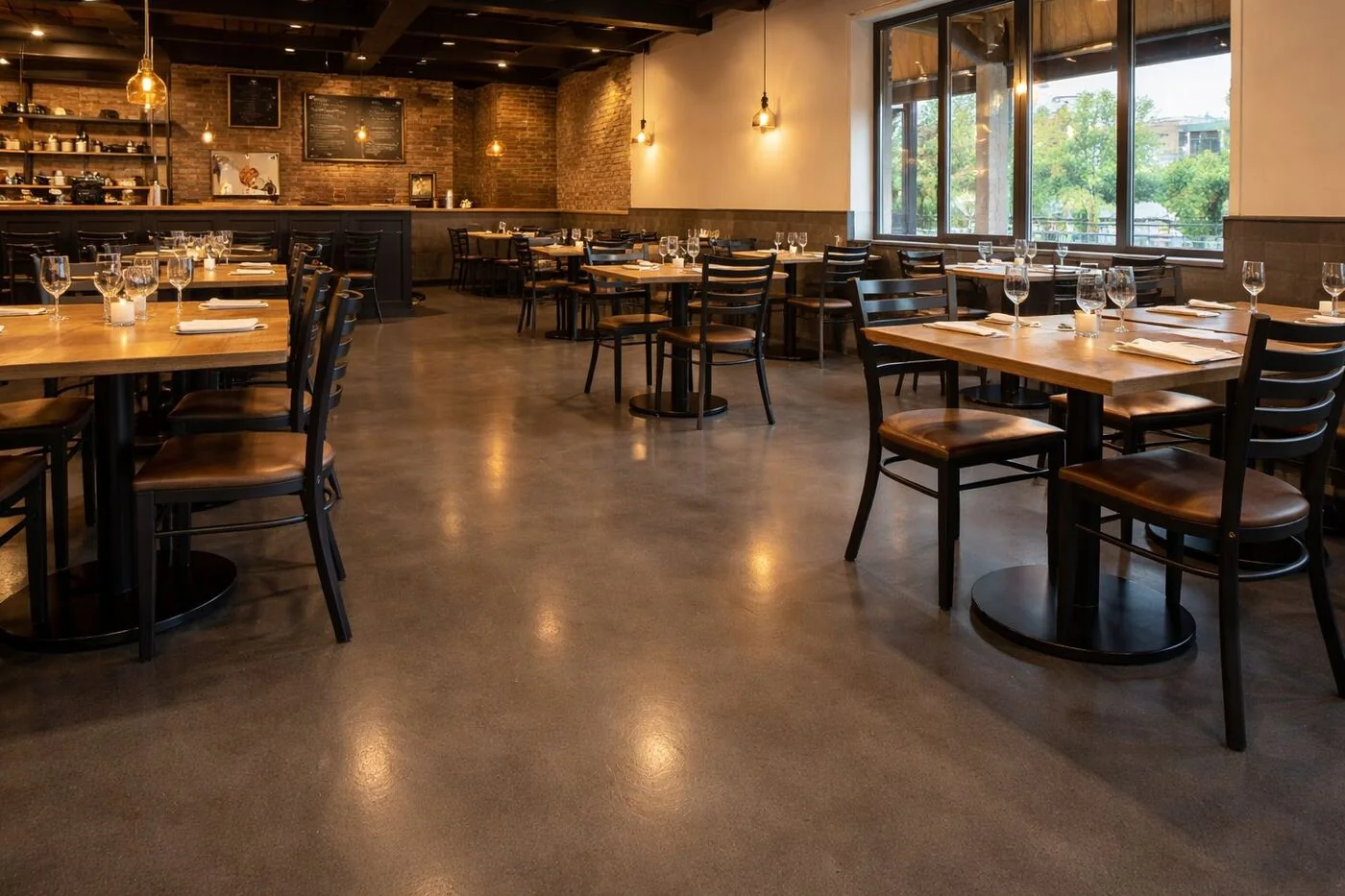
Commercial epoxy flooring gives a Pittsburgh business a durable, seamless, sanitary, slip-resistant floor that handles forklifts, foot traffic, chemicals, and daily wash-downs — and the right system depends entirely on what your industry puts that floor through. A distribution warehouse, a commercial kitchen, a car dealership showroom, and a medical clean room all need a coating, but they do not need the same coating. Spec the wrong one and you are repainting in eighteen months; spec the right one and you get a decade or two of low-maintenance service.
This guide walks through why epoxy wins for commercial spaces, which system fits each major industry, the local Pittsburgh factors that change the math, what it costs, and how we keep your doors open while we install. We pull pricing straight from our Pittsburgh epoxy cost guide so the numbers here stay consistent with what we quote across Allegheny County and Western Pennsylvania.
Why Pittsburgh Businesses Choose Epoxy
For a commercial operation, the floor is infrastructure. It either supports the work quietly for years or it becomes a recurring line item of patches, repaints, and safety complaints. A properly installed commercial epoxy floor earns its keep across six dimensions at once.
- Durability. A high-build epoxy or urethane system absorbs forklift traffic, pallet-jack wheels, dropped tools, and rolling carts without chipping or gouging the way bare concrete and tile do.
- Seamless and sanitary. Epoxy cures into one continuous, pore-free surface with no grout lines or seams for grease, bacteria, or moisture to hide in — the reason health inspectors favor it in food and medical spaces.
- Slip resistance. Broadcasting quartz or an anti-slip aggregate into the top coat builds texture that keeps the floor grippy even when it is wet, greasy, or covered in shop fluids.
- Chemical resistance. The right resin shrugs off motor oil, brake fluid, cleaning chemicals, food acids, and battery acid that would etch or stain raw concrete.
- Easy cleaning. A seamless floor sweeps, mops, and pressure-washes clean in a fraction of the time, which lowers labor cost every single day it is in service.
- It looks professional. A clean, uniform, color-coded floor signals to customers, inspectors, and employees that the operation is run well — and lets you mark safety lanes and zones directly into the surface.
The Right System by Industry
The single most important decision in a commercial floor is matching the system to the work. Here is how that shakes out across the industries we serve most around Pittsburgh.
Warehouses & Distribution
Warehouses live and die on abrasion resistance. A high-build solid epoxy or a full-flake system with a polyaspartic top coat gives you a thick, impact-resistant wear surface that takes forklift and pallet-jack traffic all day without breaking down. The seamless finish sweeps clean, reflects overhead light to brighten the space, and lets you paint permanent safety lanes, dock markings, and zone striping directly into the floor. For the heaviest-duty distribution and manufacturing floors, our industrial epoxy systems step up to thicker mil builds and tougher resins.
Restaurants & Commercial Kitchens
Commercial kitchens are the hardest sanitary environment a floor will face: standing water, grease, food acids, and boiling wash-downs, all under a health inspector's eye. A USDA-friendly quartz broadcast or urethane cement system is the answer. It gives you a seamless, non-porous surface that meets sanitation standards, a slip-rated texture that holds traction when the floor is wet and greasy, and thermal-shock resistance so the coating does not crack when scalding water hits it at the dish area. The cove base detail — running the coating up the wall a few inches — eliminates the floor-to-wall seam where grime collects.
Retail & Showrooms
Retail floors have to look as good as they perform. A decorative metallic or full-flake system delivers a polished, high-end finish — the swirling, light-reflecting look that makes a showroom or boutique feel premium — while still standing up to shopping carts, display fixtures, and constant foot traffic. You get durability and design in one floor, with a top coat that holds its shine and wipes clean. It is a common choice for dealership showrooms, fitness studios, breweries with a taproom, and boutique retail across the Strip District and Lawrenceville.
Auto Shops & Dealerships
An auto shop floor sees everything corrosive: motor oil, brake fluid, antifreeze, gasoline, and battery acid, plus the brutal "hot-tire pickup" effect where warm tires lift a weak coating right off the slab. A chemical-resistant epoxy with a polyaspartic top coat resists oil and fluid staining, shrugs off hot-tire pickup, and cleans up with a mop instead of a degreaser-and-elbow-grease routine. For the service bay floor it is about chemical and impact resistance; for the showroom next door it is about looks — and epoxy does both under one roof.
Medical & Clean Spaces
Clinics, labs, dental offices, and veterinary facilities need a floor that can be decontaminated, not just mopped. A seamless epoxy or urethane system with an antimicrobial additive leaves no grout lines or seams for pathogens to colonize, resists the harsh disinfectants used in medical cleaning, and cleans down to a sanitary surface quickly. The continuous, cove-based finish is exactly what infection-control protocols call for, which is why so many Pittsburgh medical build-outs specify epoxy from the start.
System-by-Industry Comparison
Here is how the four workhorse commercial systems stack up. Use it as a starting point — we confirm the exact spec after we test your slab and understand how the space is used.
| System | Best Industry Fit | Durability | Chemical / Slip Resistance | Relative Cost |
|---|---|---|---|---|
| Solid Epoxy (high-build) | Warehouses, storage, general commercial | High | Moderate chemical / good slip with aggregate | $ |
| Full-Flake + Polyaspartic | Retail, showrooms, auto shops, light commercial | High | Good chemical / good slip | $$ |
| Quartz Broadcast | Commercial kitchens, restaurants, medical | Very high | High chemical / excellent slip | $$$ |
| Urethane Cement | Food processing, breweries, heavy industrial, wash-down areas | Highest | Excellent chemical / excellent slip + thermal shock | $$$$ |
Pick your size, finish, and color. Get your Pittsburgh price range in 60 seconds.
Open Floor Studio →The Pittsburgh Factor
Commercial epoxy in Pittsburgh carries a few local realities that a national contractor will not plan for. Getting these right is the difference between a floor that lasts and one that fails at the worst possible spot.
Cold-Cure Scheduling So You Don't Shut Down in Winter
Standard epoxy needs a slab temperature near 50–55°F to cure, which makes a cold Pittsburgh concrete floor a problem from roughly November through March. The fix is chemistry, not a heater: polyaspartic and polyurea systems cure cold and cure fast — some as low as -20°F — so we can install through winter without parking your operation for a week waiting on a coating to set. For a business that cannot afford to close during the slow season to redo a floor, cold-cure scheduling is the whole game.
Road Salt at Entries and Loading Docks
Every winter, PennDOT and your own crews track de-icing salt across thresholds, entries, and loading-dock aprons. Salt is brutal on a coating's bond, and the entry zones are exactly where commercial floors fail first. We spec a salt-rated polyaspartic top coat in those high-exposure areas so the floor resists the chloride attack that eats cheaper systems at the door.
Freeze-Thaw on Loading Docks and Exterior-Adjacent Slabs
Loading docks, drive-in bays, and any slab that sits near an exterior wall ride Pittsburgh's freeze-thaw cycle all winter — concrete that expands and contracts as it freezes and thaws over and over. A rigid coating cracks under that movement; a flexible polyaspartic or urethane system is engineered to move with the slab. On exterior-adjacent commercial floors we never use a brittle standard epoxy top coat, because the freeze-thaw line is where it lets go first.
Cost and What Drives It
Commercial pricing tracks the same systems and the same per-square-foot ranges as our residential work, but the numbers move with scale. Quartz broadcast runs roughly $8–$15 per square foot and urethane cement $12–$25 per square foot. At a project level, most restaurant and retail jobs land between $4,000 and $30,000, while warehouse and industrial floors run from $10,000 to $100,000 or more depending on square footage.
Four factors move your final number:
- Square footage and scale. Per-foot cost drops as the job gets bigger — mobilization, grinding equipment, and crew time spread across more area, so a 10,000 sq ft warehouse costs far less per foot than a 500 sq ft kitchen.
- Prep and moisture. The condition of your slab drives prep cost. Older Pittsburgh slabs without a vapor barrier need moisture testing and sometimes a mitigation primer before any coating goes down; skipping that step is the number-one cause of commercial floor failure.
- System choice. A high-build solid epoxy warehouse floor sits at the bottom of the range; a USDA quartz kitchen or a urethane-cement brewery floor sits at the top because the materials and labor are more involved.
- Downtime requirements. A floor that has to go in overnight or in phases to keep you open costs more to schedule than one we can install with the space empty for a few days.
For the full system-by-system breakdown and what a legitimate quote should include, see our Pittsburgh epoxy flooring cost guide.
Ready to Get Your Pittsburgh Quote?
Every commercial space is different. Call us for a free, no-obligation estimate tailored to your facility, your industry, and your schedule.
Minimizing Downtime
For most businesses, the real cost of a new floor is not the coating — it is the days the space sits idle while it cures. We plan every commercial install around your operating hours, not ours, using two main levers.
Off-Hours and Phased Installs
A restaurant gets its kitchen floor done between close and open. A warehouse gets sectioned so half the floor stays in service while the other half cures, then we swap. A retail store gets the work done on a slow weekday or overnight. Phasing a large floor into zones means the business never fully stops — you lose a corner of the operation for a day, not the whole building for a week.
Fast-Cure Polyaspartic for One-Day Turnarounds
The same cold-curing polyaspartic that lets us install in winter also cures fast in any season. For the right space we can grind, coat, and return a floor to light service in a single day — a one-day turnaround that a traditional multi-day epoxy build simply cannot match. When downtime is the constraint, fast-cure is how we hit your schedule without cutting corners on prep.
Frequently Asked Questions
How much does commercial epoxy flooring cost in Pittsburgh?
Most commercial restaurant and retail projects in Pittsburgh run $4,000 to $30,000, while warehouse and industrial floors run $10,000 to $100,000 or more depending on square footage. Per square foot, quartz broadcast systems run $8 to $15 and urethane cement runs $12 to $25. The per-foot cost drops as the job gets larger, because mobilization and prep are spread across more area. Your final number depends on slab condition, moisture readings, the system the space needs, and how much downtime the schedule allows.
How long does a commercial epoxy install take?
A typical commercial install runs two to five days depending on square footage, the number of coats, and prep needs. Diamond grinding and crack repair take the first day, then base coat, decorative layer, and top coat each need cure time between them. A fast-cure polyaspartic system can compress a small space into a one-day turnaround, which is why we use it for off-hours and weekend installs when a business cannot close.
Can you install in winter without closing my business?
Yes. Standard epoxy needs a slab temperature near 50 to 55 degrees Fahrenheit to cure, which limits cold-weather work, but polyaspartic and polyurea systems cure as low as -20 degrees Fahrenheit and set fast. That lets us schedule winter and off-hours installs in phases or overnight so your floor is ready before you reopen. We plan the schedule around your operating hours, not the other way around.
Is epoxy slip-resistant enough for a kitchen?
Yes, when it is specified correctly. For commercial kitchens we broadcast an aggregate such as quartz or an anti-slip additive into the top coat to build texture, which keeps the floor grippy even when it is wet or greasy. A quartz or urethane cement system gives you a sanitary, slip-rated, thermal-shock-resistant surface that holds up to hot water wash-downs at the dish area.
Which epoxy system is best for a warehouse?
For most Pittsburgh warehouses and distribution centers we recommend a high-build solid epoxy or a full-flake system with a polyaspartic top coat. It handles forklift traffic, pallet-jack wheels, and constant abrasion, resists dropped tools and impact, and gives you a seamless surface that is easy to sweep and keep marked for safety lanes. Where heavy chemicals or thermal cycling are in play, urethane cement is the tougher choice.
How long will a commercial epoxy floor last?
A professionally installed commercial epoxy floor typically lasts 10 to 20 years or more, depending on the system and how hard the space works it. The top coat is the wear layer, so a high-traffic warehouse or kitchen may want a re-coat at some point to refresh the surface, which is far cheaper than a full replacement. Proper diamond-grind prep and moisture testing at install are what make that lifespan realistic rather than optimistic.
Related Articles
How Much Does Epoxy Flooring Cost in Pittsburgh? (2026 Price Guide)
Real Pittsburgh pricing by system type, square footage, and the local factors that affect cost.
How Pittsburgh's Climate Affects Epoxy Floor Durability
Why freeze-thaw cycling and road salt make the right system — and the right prep — non-negotiable here.