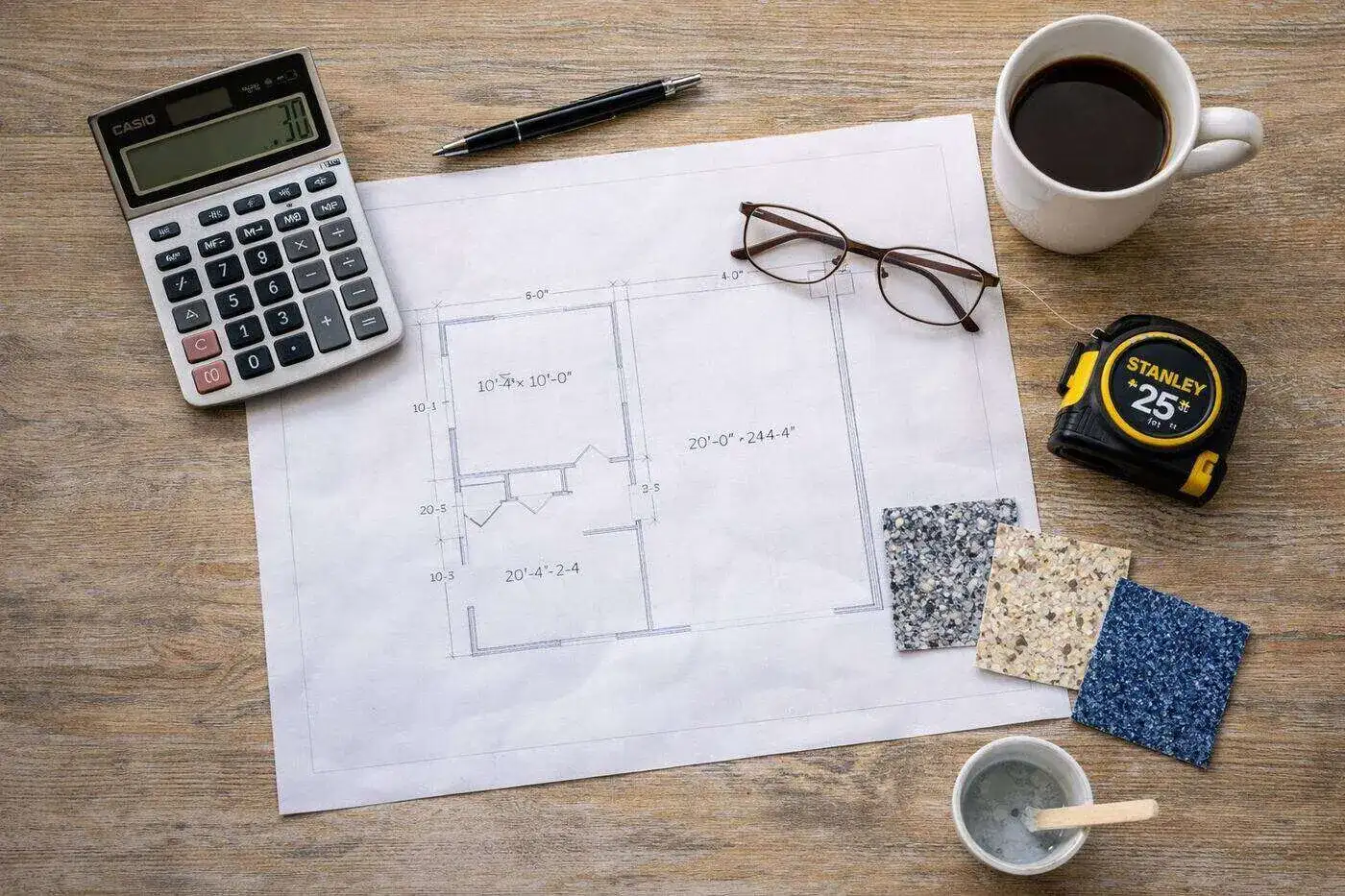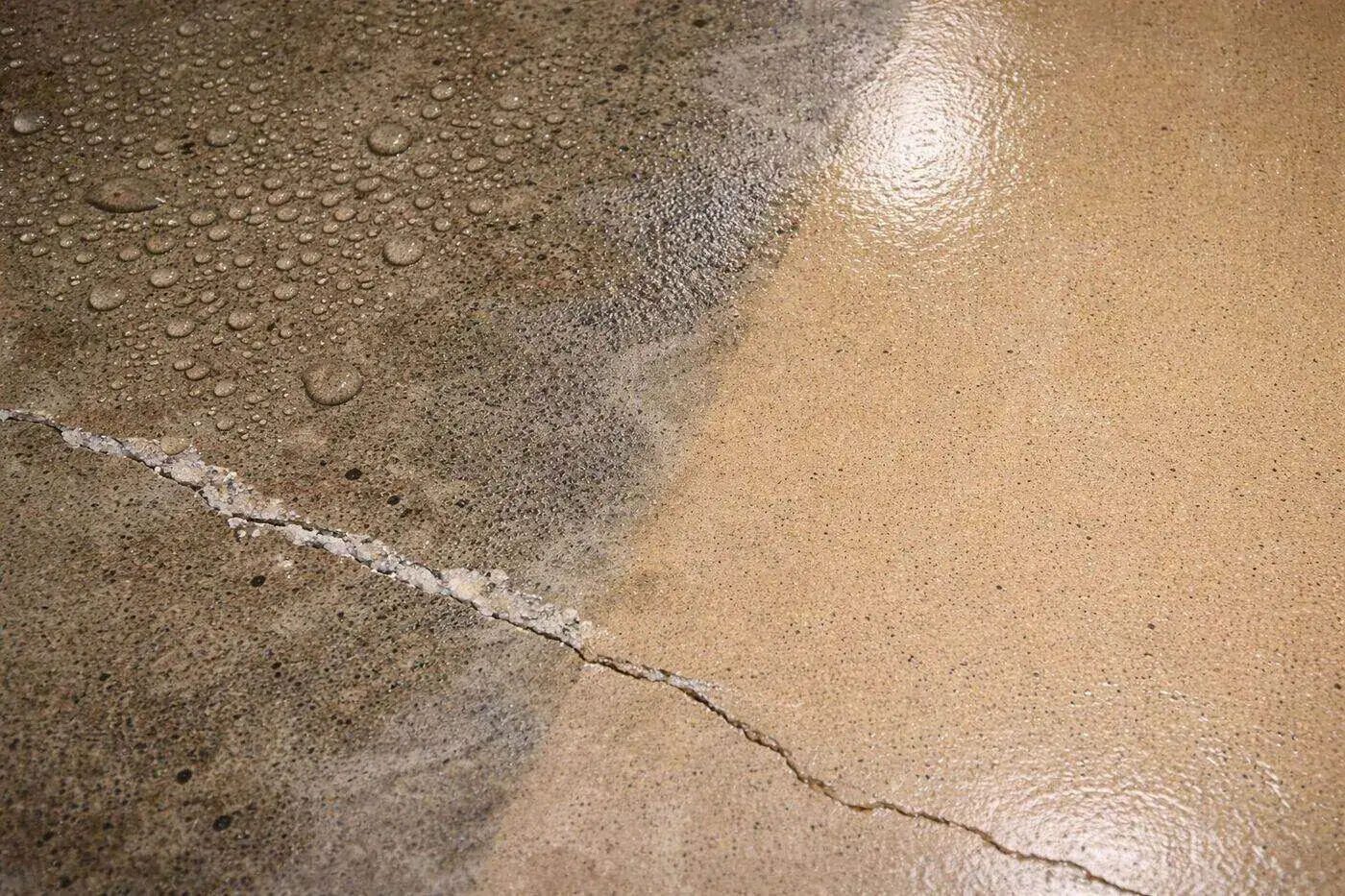
Epoxy floors do not all age the same way. A coating that performs beautifully for 20 years in a heated Phoenix garage will not necessarily last five winters in Pittsburgh, even if it is the same product from the same manufacturer. The reason is climate. Pittsburgh's combination of road salt, freeze-thaw cycling, slab-temperature swings, and pre-1970 concrete moisture is one of the harder operating environments for any concrete coating in the country — and the only way to get a long-lasting floor here is to design the system around those specific conditions.
This guide walks through how Pittsburgh's climate actually affects epoxy floor durability, where most local installs fail, and what 20-year performance really requires in this market. Whether you are coating a new garage epoxy floor or planning a basement project as part of a broader residential epoxy install, the climate considerations are the same.
If you have already read our companion piece on why Pittsburgh epoxy floors peel at the garage door, this guide goes deeper on the climate science behind that pattern and extends it to basements, walkout slabs, and the long-term maintenance routine that keeps a floor intact through 20 winters of road salt.
The 4 Climate Factors That Destroy Epoxy in Pittsburgh
Before getting into solutions, it helps to be specific about what the local environment actually does to a coating. Four factors converge in this market in a way they do not anywhere else.
1. PennDOT road salt
PennDOT spreads roughly 600,000 tons of road salt across Pennsylvania highways every winter. Every car driven on a salted street drops dissolved chloride brine on your driveway, your threshold, and the first foot or two of your garage floor. Chloride ions slowly attack standard epoxy at the surface and wick into any micro-crack or pinhole in the coating, where they accelerate freeze-thaw damage from underneath. The threshold zone of a Pittsburgh garage absorbs more chloride exposure in one winter than most floors in dry climates see in a decade.
2. ~65 freeze-thaw cycles per year
The Pittsburgh metro averages about 65 freeze-thaw cycles annually. Pair that with 44.1 inches of annual snow at KPIT (NOAA) and January average lows of 21°F, and you get a slab that physically expands and contracts dozens of times every winter. Water trapped in the slab freezes and expands roughly 9% in volume during each cold snap, then contracts on thaw. A coating that is not specifically engineered for this kind of cyclical movement, on a slab that was not properly prepared to handle it, will fail at the bond line.
3. Humidity inversions and slab condensation
Pittsburgh's geography — sitting at the confluence of three rivers, surrounded by hills — produces frequent humidity inversions, particularly in the spring and fall. When warm, humid air settles over a cold slab, the slab surface temperature drops below the dew point and a thin film of condensation forms across the concrete. Any coating applied or curing during a condensation event will fail at the bond line, often invisibly until the next freeze-thaw cycle peels it. Professional Pittsburgh installers track substrate temperature and dew point continuously, not just ambient conditions.
4. Slab-temperature cure failures
Standard 100%-solids epoxy needs ambient and slab temperatures of roughly 50 to 55°F to cure properly. In the Pittsburgh metro, that puts the reliable install window for standard epoxy at roughly mid-April through mid-October. Slabs poured on grade in unheated garages can stay below 50°F well into May and drop back below it in October. Many local installs that fail were applied in an off-season window when the resin gelled but never reached full crosslink density. The floor looks fine on day one and starts powdering or chipping by the second winter.
The Slab-Temp Problem — Standard Epoxy April-October, Polyaspartic Year-Round
The single most overlooked issue in Pittsburgh epoxy installs is the temperature of the concrete itself, not the air. The technical data sheet on every standard epoxy product specifies a minimum slab temperature — typically 50°F, sometimes 55°F — and a minimum cure temperature held for 24 to 72 hours after application. That is a hard chemistry limit, not a guideline.
In practice, this means standard epoxy in a Pittsburgh garage has a reliable install window from roughly mid-April through mid-October. Outside that window, the slab itself is too cold for the resin to crosslink fully, and the result is a coating that looks cured on the surface but is brittle, weakly bonded, and prone to chipping and powdering once it sees salt.
Polyaspartic — a polyurea chemistry originally engineered for chloride-exposed bridge decks — solves the seasonal problem. Polyaspartic systems cure down to roughly -20°F, which means a polyaspartic floor can be installed in a Pittsburgh garage in January if needed. For a homeowner who wants a floor done in February or November and is being told by a contractor that it will be "fine," the right follow-up question is, "What is the cure-temperature minimum on the technical data sheet for the product you are using?" If the answer is 50°F and the slab is at 38°F, walking away is the correct move.
For year-round installation in Pittsburgh, the practical playbook is an epoxy base coat during the warm-season window and a polyaspartic top coat (which can be applied later if needed), or a full polyaspartic system year-round. Either approach is honest about the chemistry; cutting corners on the cure-temperature spec is not.
Salt + Freeze-Thaw Chemistry at the Threshold
The single most common failure pattern on Pittsburgh epoxy floors — chipping and curling at the garage door opening within 6 to 18 months — is a direct consequence of salt and freeze-thaw chemistry concentrating at the threshold. Tires drop slush, brine, and grit on that strip every time you pull in. Sunlight hits it directly when the door is open. Snow piles against the outside edge and melts inward.
The chemistry that destroys an unprotected coating works in two directions at once. From above, dissolved chloride brine wicks into any micro-crack or surface pinhole. From below, water trapped in the slab freezes, expands roughly 9%, and contracts again on thaw — sixty-five times per year. Each cycle pushes salt-laden moisture deeper into the coating-to-slab bond line. Once the bond is compromised at the edge, the next freeze-thaw cycle peels a chip, and the failure walks inward from the door opening.
The defenses against this are well-known and well-specified, but they cost more than the alternative. Diamond grinding to a CSP-3 minimum gives the coating a deep mechanical anchor. A salt-rated polyaspartic top coat at the threshold zone resists chloride attack and stays bonded through freeze-thaw. Routed and flexibly-filled control joints absorb slab movement instead of letting it telegraph through the coating. None of this is exotic — it is what coating-manufacturer technical data sheets call for in a Pittsburgh climate zone — but it is also what cheap quotes leave out.
Pre-1970 Slabs and Old-House Basement Moisture
Climate is half the story. The other half is the building stock. The median Allegheny County home was built in 1954, roughly 60 to 70% of housing in the county is pre-1970, and about 36% of homes are pre-1950. That matters because vapor barriers under concrete slabs did not become standard practice in residential construction until the 1970s. Most Pittsburgh basement and garage slabs from before that era were poured directly on grade with nothing between the soil and the concrete.
The consequence is that moisture moves freely up through these slabs, year-round, driven by hydrostatic pressure from the water table and capillary action through the concrete itself. The moisture is often invisible — no visible puddle, no obvious damp spot — but it is constant. A coating applied over a pre-1970 slab without a moisture diagnostic and a properly specified moisture-mitigation primer is a coating that will bubble, peel, or delaminate from underneath, regardless of how good the surface prep was.
Pittsburgh's hilly terrain compounds the problem. Walkout basements are common across Mt. Lebanon, Sewickley, Fox Chapel, Wexford, Squirrel Hill, Bethel Park, Upper St. Clair, Peters Township, and the broader hillside neighborhoods. Walkout slabs sit partially below grade on the uphill side, which means the uphill wall and slab edge are subject to hydrostatic pressure from saturated soil while the downhill side is open to the air. That asymmetric moisture loading produces moisture readings that vary across a single slab, and the only way to spec the right system is to test multiple points.
The diagnostic standard for slab moisture is ASTM F2170, the in-situ relative humidity test. Calibrated probes are drilled into the concrete to 40% of the slab depth, allowed to stabilize per the standard, and read. Internal RH below about 75% is typically safe for standard epoxy systems; readings above that call for a moisture-mitigation primer or a vapor-reduction barrier before the topcoat goes down. On any pre-1970 Pittsburgh slab, skipping that test is a gamble — and the odds are not on the homeowner's side.
Planning a Pittsburgh Epoxy Project?
Every pre-1970 slab should be moisture-tested and the system specced around the data — not the other way around. Free, no-pressure quote.
Request a Free QuoteHow to Maintain an Epoxy Floor Through Pittsburgh Winters
A correctly installed Pittsburgh epoxy floor will last 10 to 20 years or more. A correctly installed and well-maintained one will sit on the upper end of that range. The maintenance routine is not complicated, but it does need to account for road salt.
- Rinse salt off the floor weekly during winter. Once a week through January, February, and early March, hose or mop down the threshold zone and the first 10 feet of the garage with clean water. Brine that sits on the coating is brine that wicks into any imperfection in the surface. Rinsing it off is the single highest-leverage habit.
- Sweep grit before driving on it. Sand and grit dropped from tires acts like sandpaper under the next set of tires. A 60-second push-broom pass once a week prevents micro-scratching and keeps the surface clear for a wash.
- Use a pH-neutral cleaner for deeper cleans. Acidic cleaners (vinegar-based, citrus-based) and high-alkaline cleaners (ammonia, harsh degreasers) can dull the gloss over time. A pH-neutral floor cleaner diluted per the label is enough for almost any household soil load.
- Spot-treat oil and chemical spills quickly. Most spills wipe off cleanly if addressed within a few minutes. Brake fluid, hydraulic fluid, and battery acid can stain or etch; keep a roll of paper towels and a spray bottle of pH-neutral cleaner in the garage.
- Inspect the threshold every spring. Once the snow is gone, walk the edge nearest the garage door and look for hairline cracks, lifting, or chipping. Catching threshold damage early — when it is a single chip rather than a peeled section — keeps repair costs low and prevents salt from getting under the coating.
- Re-coat the threshold zone before the rest of the floor needs it. Even on a well-maintained Pittsburgh floor, the threshold sees more abuse than the body of the slab. A fresh polyaspartic top coat on the first 24 inches every 5 to 8 years is much cheaper than a full re-do and extends the working life of the original system substantially.
What "20-Year Durability" Actually Requires in Pittsburgh
Coating manufacturers publish service-life ranges of 10 to 30 years for residential epoxy and 5 to 20 years for commercial. Those numbers are real, but they are also conditional on the install matching the climate. In Pittsburgh, hitting the upper end of those ranges is a function of doing the obvious things consistently:
- ASTM F2170 moisture testing on every pre-1970 slab. Spec the system around the data, not the other way around.
- Diamond grinding to a documented CSP-3 minimum. No acid etching shortcuts.
- Active crack and joint detailing. Routed cracks filled with flexible polyurea joint filler that flexes with the slab.
- Salt-rated polyaspartic top coat at the threshold zone. The chemistry that road salt actually touches has to be designed for chloride exposure.
- Honest scheduling around slab temperature. Standard epoxy installs in the April-October window; polyaspartic for off-season work; no "we'll just throw a heater in there" hand-waving.
- A simple winter maintenance routine. Weekly threshold rinse, annual spring inspection, threshold re-coat every 5 to 8 years.
None of these steps are individually exotic. The reason most Pittsburgh floors do not hit 20 years is that almost every install skips at least one of them — usually the moisture test or the polyaspartic top coat or both — to keep the quote competitive.
Frequently Asked Questions
How long does an epoxy floor last in Pittsburgh?
A properly installed system designed for the local climate lasts 10 to 20+ years for residential and 5 to 20 years for commercial. Hitting the upper end in Pittsburgh depends on doing the obvious things consistently: moisture testing every pre-1970 slab, diamond grinding instead of acid etching, flexible crack detailing, and a salt-rated polyaspartic top coat at the threshold. Most local floors fall short because the install skips at least one of those steps to stay cheap.
Why does road salt damage epoxy floors here?
PennDOT spreads roughly 600,000 tons of road salt across Pennsylvania every winter, and cars track dissolved chloride brine onto your driveway and the first foot or two of your garage floor. Chloride ions attack standard epoxy at the surface and wick into any micro-crack or pinhole, where they accelerate freeze-thaw damage from underneath. The threshold zone absorbs more chloride in one Pittsburgh winter than most floors in dry climates see in a decade.
What is the best time of year to install an epoxy floor in Pittsburgh?
Standard epoxy installs best from roughly mid-April through mid-October, because it needs a slab temperature of 50-55F to cure properly and an unheated garage slab often runs colder well into spring. Winter installs are possible but require polyaspartic or polyurea systems that cure as low as -20F. For year-round durability against salt and freeze-thaw, a salt-rated polyaspartic top coat is the right call regardless of season.
Do pre-1970 Pittsburgh slabs really need moisture testing?
Yes. Most pre-1970 Allegheny County homes were built before vapor barriers under slabs were standard, so hydrostatic pressure pushes moisture up through the concrete and pops any coating off from underneath. Professional prep includes ASTM F2170 in-situ relative humidity testing, plus a moisture-mitigation primer or vapor reduction barrier when the readings warrant it. Skipping the test is the single most common reason a Pittsburgh floor fails early.
How many freeze-thaw cycles does a Pittsburgh floor go through?
Pittsburgh sees roughly 65 freeze-thaw cycles a year. Each cycle expands and contracts the slab and any water trapped in micro-cracks, which works a brittle or poorly bonded coating loose over time. A flexible crack-detailing approach and a top coat engineered for the climate are what let a floor ride out that cycling for two decades instead of two winters.
What maintenance keeps an epoxy floor lasting in Pittsburgh winters?
The routine is simple: rinse road salt off the threshold weekly through the winter, do an annual spring inspection, and plan on a threshold re-coat every 5 to 8 years where salt exposure concentrates. Keeping grit knocked off so it does not scratch the surface and wiping up snowmelt before it sits also helps. None of it is labor-intensive, but skipping the winter salt rinse is what shortens floors the most here.
Get a Free Pittsburgh Epoxy Quote
If you are planning an epoxy project anywhere in Allegheny, Westmoreland, Washington, Butler, or Beaver county — whether it is a Mt. Lebanon basement, a Sewickley garage, a Cranberry Township showroom, or a UPMC-corridor commercial space — we are happy to walk the slab, run the moisture test, and give you an honest written quote built around what your specific concrete actually needs.
Call (412) 388-9880 or request a free quote to get started. For what moves the price, see our 2026 Pittsburgh epoxy flooring cost guide; for the threshold-failure deep dive, our guide on why Pittsburgh epoxy floors peel at the garage door covers the most common failure mode and how we prevent it.