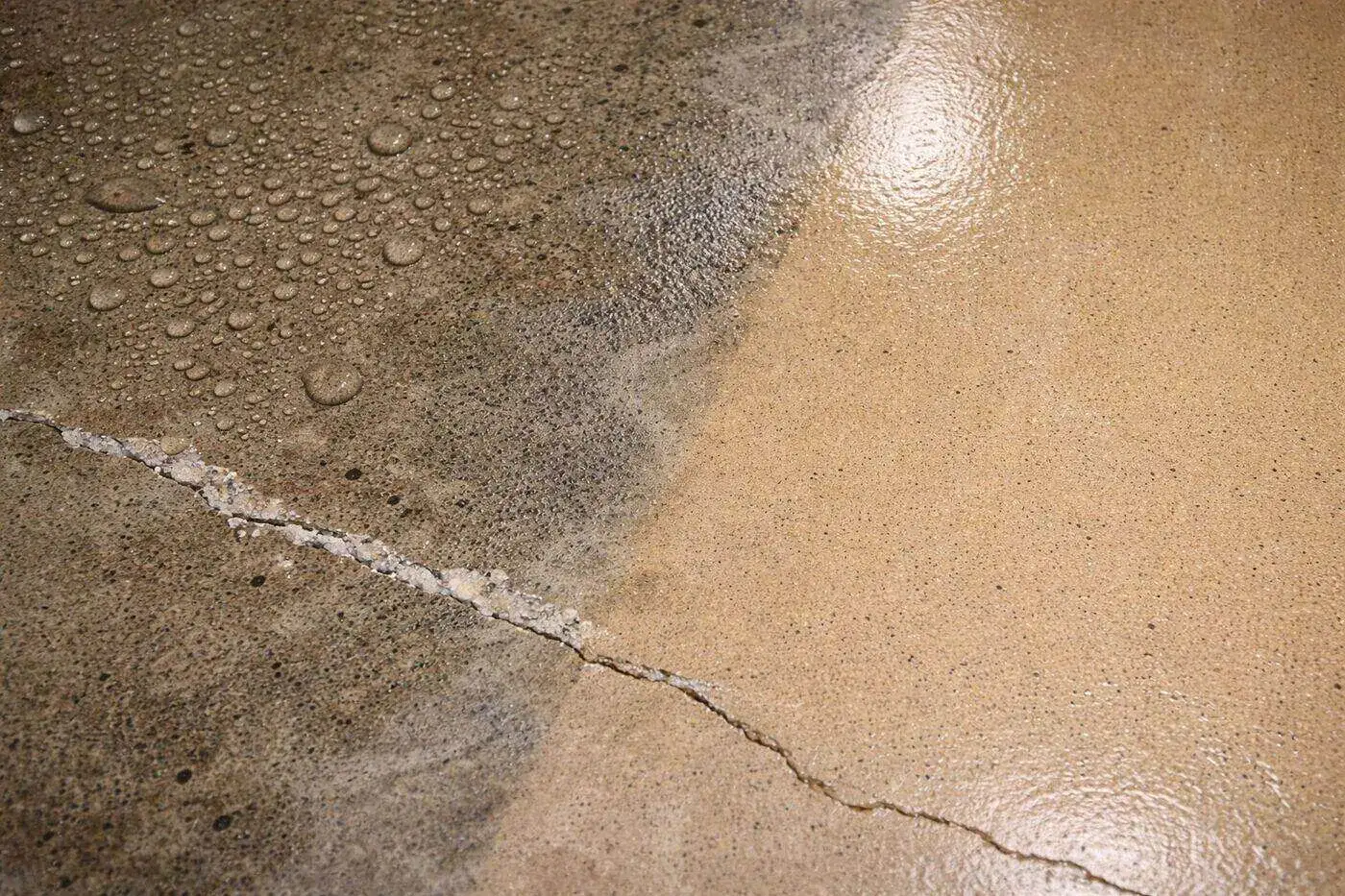
If you're weighing epoxy against polyaspartic for a Pittsburgh garage, here's the short answer: for most homes around Allegheny County, the smart move isn't picking one — it's a hybrid system that uses both. An epoxy base coat gives you a thick, economical, strongly bonded build layer, and a polyaspartic topcoat gives you the fast cure, cold-weather curing, UV stability, and abrasion plus road-salt resistance that Pittsburgh winters demand.
People tend to frame this as "epoxy vs. polyaspartic," like they're rivals. In a properly engineered floor they're teammates. Epoxy does what epoxy is good at — bonding to prepared concrete and building thickness for less money. Polyaspartic does what it's good at — curing in the cold, holding its color in sunlight, and laughing off salt. Stacked together, they outperform either material used alone.
That said, the right answer depends on your space. A sunlit garage that sees PennDOT road salt every winter has very different needs than a climate-controlled basement that never sees a snow tire. Below we break down what each material actually is, put them head-to-head, and tell you which to choose for common Pittsburgh scenarios.
What Epoxy Actually Is
Epoxy is a two-part thermosetting coating: you mix a resin with a hardener, and a chemical reaction turns the liquid into a hard, plastic-like film bonded to your concrete. It's been the workhorse of the garage floor world for decades, and for good reason — it builds thick, it's economical, and on properly prepared concrete it bonds extremely well.
Where epoxy shines
- Thickness per coat. Epoxy is high-build — a single coat lays down thicker than polyaspartic, so it fills minor surface imperfections and creates a substantial base.
- Cost. Per gallon, epoxy is the more economical material, which is why it makes such a good base coat.
- Adhesion. Over a diamond-ground, moisture-tested slab, epoxy grips concrete tenaciously and forms the foundation a topcoat can lock onto.
Where epoxy struggles in Pittsburgh
- Slow cure. Epoxy typically needs 12–24 hours between coats and several days before you can park on it — and that stretches in the cold.
- Temperature-sensitive. It needs a slab around 50–55°F to cure properly, which rules out much of the Pittsburgh calendar in an unheated garage.
- Not UV-stable. Direct sunlight ambers and yellows bare epoxy over time.
- Less abrasion and salt resistance than polyaspartic when left exposed.
What Polyaspartic (Polyurea) Is
Polyaspartic is a type of polyurea — a fast-reacting coating chemistry originally developed for industrial and protective applications. Like epoxy, it's a two-part system, but it cures far faster and across a much wider temperature range. In a floor system, it's most often used as the high-performance topcoat over an epoxy or primer base.
Where polyaspartic shines
- Fast cure. Often walkable in an hour or two and ready for vehicle traffic in roughly 24 hours — which is what makes one-day garage installs possible.
- Cold cure. Cures in cold conditions, some formulations as low as -20°F, so winter installs are genuinely on the table.
- UV stability. Holds its color in sunlight where epoxy yellows.
- Abrasion and salt resistance. Stronger surface durability against PennDOT road salt, brine, and daily freeze-thaw cycling.
Where polyaspartic struggles
- Thin per coat. Polyaspartic is a thinner film than epoxy, so building a floor on polyaspartic alone takes more product.
- Short pot life. It kicks fast in the bucket, leaving a narrow working window — which makes it unforgiving for DIY and demanding to install well.
- Cost. It's more expensive per gallon than epoxy, so an all-polyaspartic build runs up the material bill.
Epoxy vs. Polyaspartic: Head-to-Head
Here's how the two materials stack up on the factors that matter most for a Pittsburgh floor.
| Factor | Epoxy | Polyaspartic |
|---|---|---|
| Cure time | 12–24 hrs between coats; days to park | Walkable in ~1–2 hrs; park in ~24 hrs |
| Cold-weather curing | Needs ~50–55°F slab | Cures as low as -20°F |
| UV stability | Ambers / yellows in sunlight | UV-stable, holds color |
| Abrasion & road-salt resistance | Good, but weaker when exposed | Excellent — resists salt & freeze-thaw |
| Thickness per coat | High-build, thick | Thin film per coat |
| Pot life / install difficulty | Forgiving working window | Short pot life; pro install needed |
| Cost per sq ft | $3 – $7 (solid color) | $5 – $12 (polyaspartic / hybrid) |
| Best use | Economical base coat; low-UV interiors | Topcoat; cold installs; salt & sun exposure |
Pick your size, finish, and color. Get your Pittsburgh price range in 60 seconds.
Open Floor Studio →Read the table top to bottom and the conclusion writes itself: epoxy wins on thickness and cost, polyaspartic wins on cure, UV, and salt. A floor that needs all of those wins shouldn't make you choose — it should use both.
Why Polyaspartic's Fast, Cold Cure Matters in PA Winters
This is the heart of the Pittsburgh-specific argument. Traditional epoxy needs a slab temperature of roughly 50–55°F to cure properly. Concrete in an unheated detached garage in places like Bethel Park, Upper St. Clair, or Wexford often sits at 35–50°F well into spring — and drops far below that in deep winter. That's why the practical install window for standard epoxy here runs only about mid-April through mid-October.
Polyaspartic rewrites that calendar. Because it cures in cold conditions — some formulations down to -20°F — a polyaspartic-forward system can be installed in the dead of a Pittsburgh winter when bare epoxy simply won't set. Its fast cure also means many garage projects can be completed in about a single day and back in service the next, instead of tying up your garage for the better part of a week.
Road salt is the year-round reason
Cold cure gets a polyaspartic floor installed in winter; salt resistance is why you'd want it there year-round. Every winter your tires carry PennDOT road salt and brine straight into the garage, where it pools under the car and attacks an unprotected surface. A salt-rated polyaspartic topcoat resists that exposure and the constant freeze-thaw cycling far better than exposed epoxy — the same failure pattern we see when cheap epoxy floors peel at the garage door. For more on how Western PA's climate drives coating choices, see our piece on Pittsburgh climate and epoxy durability.
The Hybrid System: Epoxy Base + Polyaspartic Top
The system we install in most Pittsburgh garages takes the best of both materials. A diamond-ground, moisture-tested slab gets an epoxy base coat for an economical, thick, well-bonded foundation; a decorative flake layer is broadcast in; and the whole thing is sealed with a salt-rated polyaspartic topcoat for cold-cure speed, UV stability, and abrasion plus salt resistance.
You get epoxy's economy and build where it counts — down at the bond line — and polyaspartic's toughness exactly where the floor meets road salt, tires, and sunlight. The wear surface is the polyaspartic, so the floor keeps its color and shrugs off the abuse a Pittsburgh winter throws at it.
What the hybrid system costs
A full-flake epoxy floor finished with a polyaspartic topcoat — the most popular residential choice in Pittsburgh — runs about $5–$12 per square foot, or roughly $2,250–$5,400 for a typical 450-square-foot two-car garage. A basic solid-color epoxy runs $3–$7 per square foot, and decorative metallic finishes run $9–$20. Because polyaspartic costs more per gallon, winter and shoulder-season installs typically add about 5–15%. For a full breakdown by system and project size, see our Pittsburgh epoxy flooring cost guide.
Ready to Get Your Pittsburgh Quote?
Every project is different. Call us for a free, no-obligation estimate tailored to your specific space and goals.
Which to Choose by Scenario
Unheated detached garage
This is the textbook case for the hybrid — or for a polyaspartic-forward system if you need it installed off-season. Cold slab temperatures, road salt, and sun through an open door all point to polyaspartic on top. A bare epoxy floor here is the one most likely to yellow and peel within a few winters.
Finished basement
A climate-controlled basement with no road salt and little or no direct sun is the one scenario where simpler epoxy — or a decorative metallic epoxy finished with a clear coat — can be a sensible, cost-effective choice. If a sunlit window hits the floor, you'll still want a UV-stable topcoat to prevent yellowing.
Showroom or living-space conversion
When appearance is the point — a Sewickley or Fox Chapel garage turned into a showroom or living space — a decorative epoxy base (often metallic) with a UV-stable polyaspartic topcoat gives you the look and the longevity. The polyaspartic keeps the finish from clouding or ambering under display lighting and sun.
Fast-turnaround commercial
For a commercial space that can't afford days of downtime, polyaspartic's fast cure is the deciding factor — a floor can often go down and be back in service with minimal closure. Pair it with the right base system for the traffic and chemical load, and you keep the doors open.
Bottom line: in Pittsburgh, the question usually isn't "epoxy or polyaspartic" — it's "how much polyaspartic, and on top of what." For a daily-driven garage exposed to salt and sun, the hybrid epoxy-base, polyaspartic-top system is the floor that lasts.
Frequently Asked Questions
Is polyaspartic better than epoxy for a Pittsburgh garage?
For most Pittsburgh garages, neither one alone is the best answer — the hybrid is. A pure epoxy floor is economical and bonds thick, but it has poor UV stability and a slow, temperature-sensitive cure. Pure polyaspartic cures fast in the cold and shrugs off road salt and sunlight, but it is thin per coat and expensive to build up alone. The system we install in most Allegheny County garages is an epoxy base coat for an economical, well-bonded build, topped with a salt-rated polyaspartic for the cold-cure speed, UV stability, and abrasion resistance Pittsburgh winters demand. So polyaspartic is better as the topcoat, and epoxy is better as the base — together they beat either material used by itself.
Can you install epoxy or polyaspartic in winter in Pittsburgh?
Standard epoxy is hard to install in a Pittsburgh winter because it needs a slab temperature of roughly 50–55°F to cure, and concrete in an unheated detached garage often sits at 35–50°F well into spring — which is why the practical epoxy window here runs about mid-April through mid-October. Polyaspartic and polyurea systems are different: they cure in cold conditions, some as low as -20°F, so a winter or shoulder-season install is genuinely possible with a polyaspartic-forward system. Because polyaspartic costs more per gallon than epoxy, winter and shoulder-season installs typically run about 5–15% more.
Does polyaspartic resist road salt better than epoxy?
Yes. Polyaspartic has stronger abrasion and chemical resistance than standard epoxy, which matters in Pittsburgh because PennDOT road salt and brine ride into the garage on your tires every winter and pool under the car. A polyaspartic topcoat resists that salt exposure and the daily freeze-thaw cycling far better than a bare epoxy surface, and it also won't yellow under UV. That is exactly why we cap our epoxy base with a salt-rated polyaspartic instead of leaving the epoxy exposed.
How long does each one take to cure?
Standard epoxy cures slowly: it usually needs 12–24 hours between coats and several days before you can park a vehicle on it, and that timeline stretches further in cold weather. Polyaspartic cures fast — often dry to walk on within an hour or two and ready for vehicle traffic in roughly 24 hours. With a hybrid epoxy-base, polyaspartic-top system, the fast polyaspartic topcoat is what lets many Pittsburgh garage projects be completed in about a day and back in service the next.
Is the hybrid system worth the extra cost?
For a daily-driven Pittsburgh garage, yes. A full-flake epoxy floor finished with a polyaspartic topcoat runs about $5–12 per square foot — roughly $2,250–$5,400 for a typical 450-square-foot two-car garage — versus $3–7 per square foot for a basic solid-color epoxy. You pay more up front, but you get the cold-cure speed, UV stability, and salt and freeze-thaw resistance that keep the floor from yellowing, peeling at the garage door, or failing in a few winters. For a low-traffic interior or storage space that never sees salt or sun, a simpler epoxy can be the right call.
Will UV from the sun yellow my floor?
Standard epoxy is not UV-stable, so direct sunlight will amber or yellow an exposed epoxy surface over time — a real concern for a garage with the door open in summer, a sunlit basement window, or any outdoor or covered patio area. Polyaspartic is UV-stable and holds its color, which is why we always use a polyaspartic topcoat (never bare epoxy) on anything that sees sunlight. That is also why outdoor and patio surfaces in Pittsburgh should use polyaspartic, not standard epoxy, on top.
Related Articles
How Much Does Epoxy Flooring Cost in Pittsburgh? (2026 Price Guide)
Honest pricing by system type, garage size, and the local prep factors that affect cost.
Will Epoxy Hold Up in Pittsburgh's Climate?
How freeze-thaw cycling and PennDOT road salt drive coating choices in Western PA.
Is Epoxy Flooring Worth It in Pittsburgh?
Weighing the cost, lifespan, and resale value of a professional epoxy floor.